The XR Hardware Shakeup: Meta Charges Forward as Apple Retreats
For three years, the XR hardware market consolidated around two competing visions: Meta’s ecosystem-first approach with Quest headsets and Ray-Ban smart glasses, and Apple’s premium spatial computing bet with Vision Pro. In one week in July 2026, both strategies shifted — in opposite directions.
Meta’s CTO confirmed the company is building multiple next-generation headsets that go beyond industry expectations. Apple quietly shelved its cheaper Vision Pro display project with Samsung and reassigned mixed-reality talent toward smart glasses. HTC pinned its survival on AI glasses and a user-generated metaverse platform. XREAL brought its budget glasses to international markets at $300.
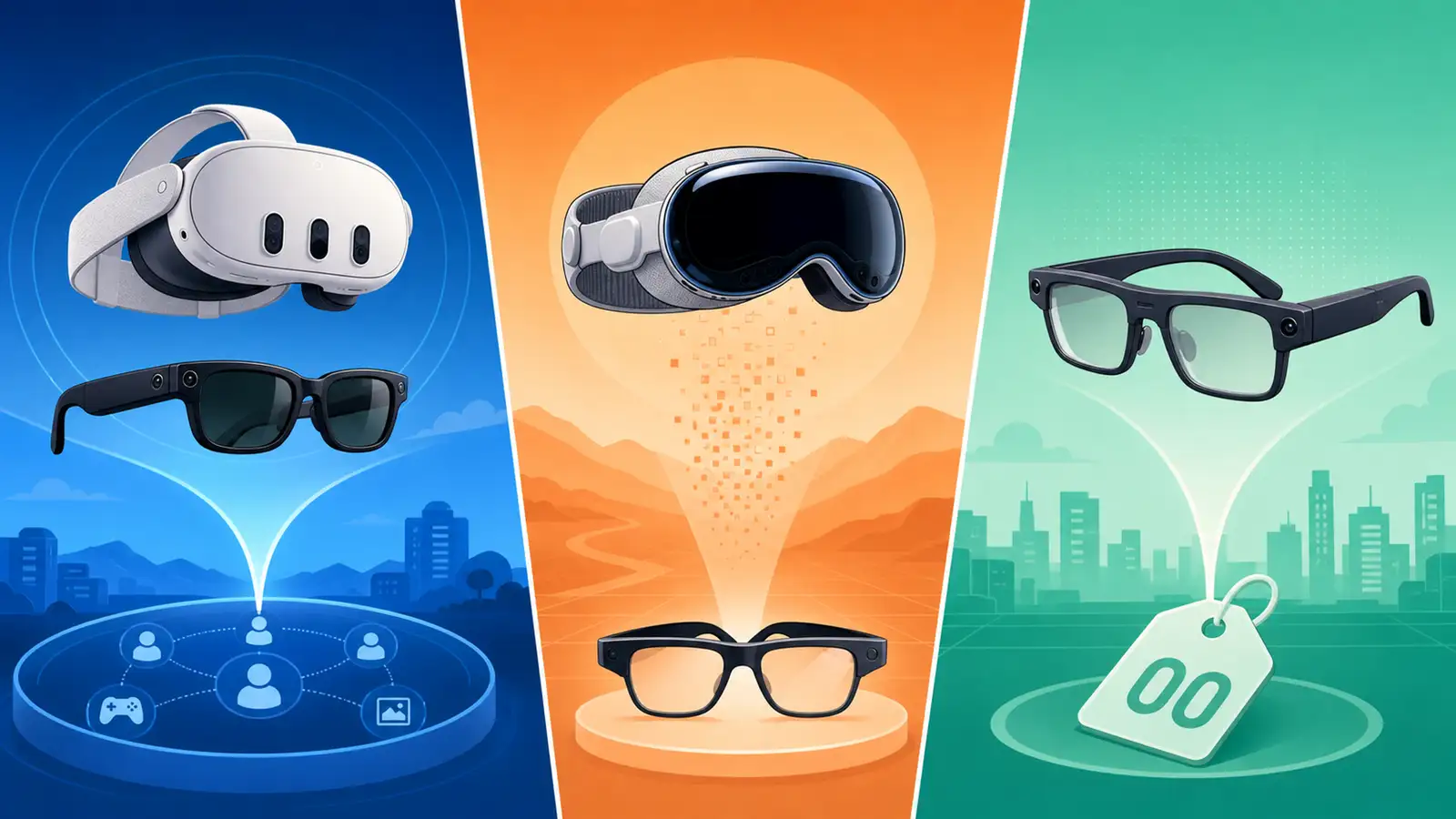
The XR hardware landscape has split into three distinct paths: the everything-everywhere platform play, the luxury-to-glasses pivot, and the race to the price floor.
Meta’s multi-device offensive
Andrew Bosworth, Meta’s CTO, used his weekly internal memo on July 9 to deliver a message that echoed through the XR industry. Meta is working on “multiple next-generation headsets,” he wrote, adding that the company had “just updated the user interface profoundly for the first time in years.”
In a subsequent interview, Bosworth went further. “I think it’s officially leaked we’ve got two devices on the roadmap that we’re super excited about coming out over the course of a period of time,” he said. These two devices sit alongside the widely reported ultralight mixed reality headset with a tethered compute puck, which internal planning targets for the first half of 2027.
The timing of Bosworth’s comments is deliberate. Meta Connect 2026 is scheduled for September 23, and Bosworth hinted at “more to share” at the event. If Meta unveils multiple hardware products at once, it would be the most ambitious XR hardware launch since the original Quest, and a signal that the company sees the next 18 months as an inflection point for spatial computing adoption.
Meta has always aimed to own the platform layer. The Quest line dominates the standalone VR market. The Ray-Ban Meta smart glasses, including the recently reviewed Fury model, have sold in the millions through Luxottica’s optical retail network. By developing headsets across multiple form factors — ultralight MR, next-gen Quest, and a display-equipped glasses model — Meta is betting that no single device will win the XR market. The winner will be the company that owns the most shelf space across all of them.
This multi-device approach mirrors the smartphone market, where Apple and Samsung dominate not because they make the single best phone but because they offer devices at every price tier and use case. Meta wants the same dynamic in XR, and Bosworth’s comments suggest the company is closer to that reality than most outsiders assumed.
Apple’s strategic pullback
Seven days before Bosworth’s memo, Korean outlet The Elec reported that Samsung Display is winding down the G-VR panel project, a glass-substrate micro-OLED display intended for a cheaper, lighter version of the Vision Pro. Development is set to end by September.
The G-VR display was a lower-cost alternative to the silicon-based OLEDoS used in the current Vision Pro. It targeted roughly 1,600 to 1,700 pixels per inch, about half the 3,386 PPI of the existing headset. Mass production had been planned for sometime after 2028. That timeline has collapsed.
This report matches what Bloomberg’s Mark Gurman has been tracking since late 2025. Apple paused work on the cheaper “Vision Air” in October 2025 to fast-track glasses that would compete with Meta’s Ray-Bans. By May 2026, Gurman reported the cheaper headset was canceled outright. Most of Apple’s mixed-reality hardware team has moved to smart glasses, now expected to launch in 2027.
Gurman says not to expect a new Vision Pro-style device for “around two more years at least.” Meanwhile, Apple raised the Vision Pro’s starting price from $3,499 to $3,699 as part of a broader round of price hikes.
The Vision Pro ecosystem did get one boost. On July 10, Apple published a 74-page technical specification document for third-party motion controllers, covering everything from LED wavelength requirements to example main logic board layouts. After two years of insisting that hand-and-eye tracking was the only acceptable input method, Apple is opening the platform to third-party controller makers. VisionOS 27, announced at WWDC last month, supports these controllers natively.
It is a pragmatic concession. Developers have wanted controller support since the Vision Pro launched. Apple publishing detailed hardware specs signals that it knows the Vision Pro needs a richer input ecosystem to attract applications — gaming, professional design, industrial training — that justify its price. This openness, coming as smart glasses platforms compete for developer attention, suggests Apple is trying to keep its existing developer base engaged while the hardware roadmap pivots toward glasses.
HTC’s survival pivot
HTC’s journey from smartphone giant to XR survivor is one of the stranger arcs in consumer electronics. The company sold much of its smartphone engineering team and IP to Google in 2018, then lost XR hardware talent to the same buyer in 2025. Its last major headset, the VIVE Focus Vision, launched in September 2024 at $1,150 and targeted enterprise customers.
At the company’s shareholders’ meeting, Chairman Cher Wang laid out a strategy that reads less like a hardware roadmap and more like a bet on platforms and AI. The VIVE Eagle, HTC’s first AI-powered smart glasses, is set to arrive in the US and Europe in Q3 2026. Wang called AI “one of the most important trends” the company is tracking.
Meanwhile, HTC’s VIVERSE metaverse platform has built a user base. Wang reported 1.7 million monthly active users in May, with more than 32,000 pieces of content and over 14,000 creators. VIVERSE has become what Wang describes as a “user-generative platform,” a shift from HTC’s earlier curated virtual environments.
The challenge, as Road to VR noted, is that HTC has not shown it can convert these user numbers into revenue growth. Revenue sits at a fraction of the company’s smartphone-era peak, and the headset business has stalled. Whether the VIVE Eagle and VIVERSE can reverse the decline is the question HTC faces in the second half of 2026.
The $300 threshold: XREAL’s mainstream play
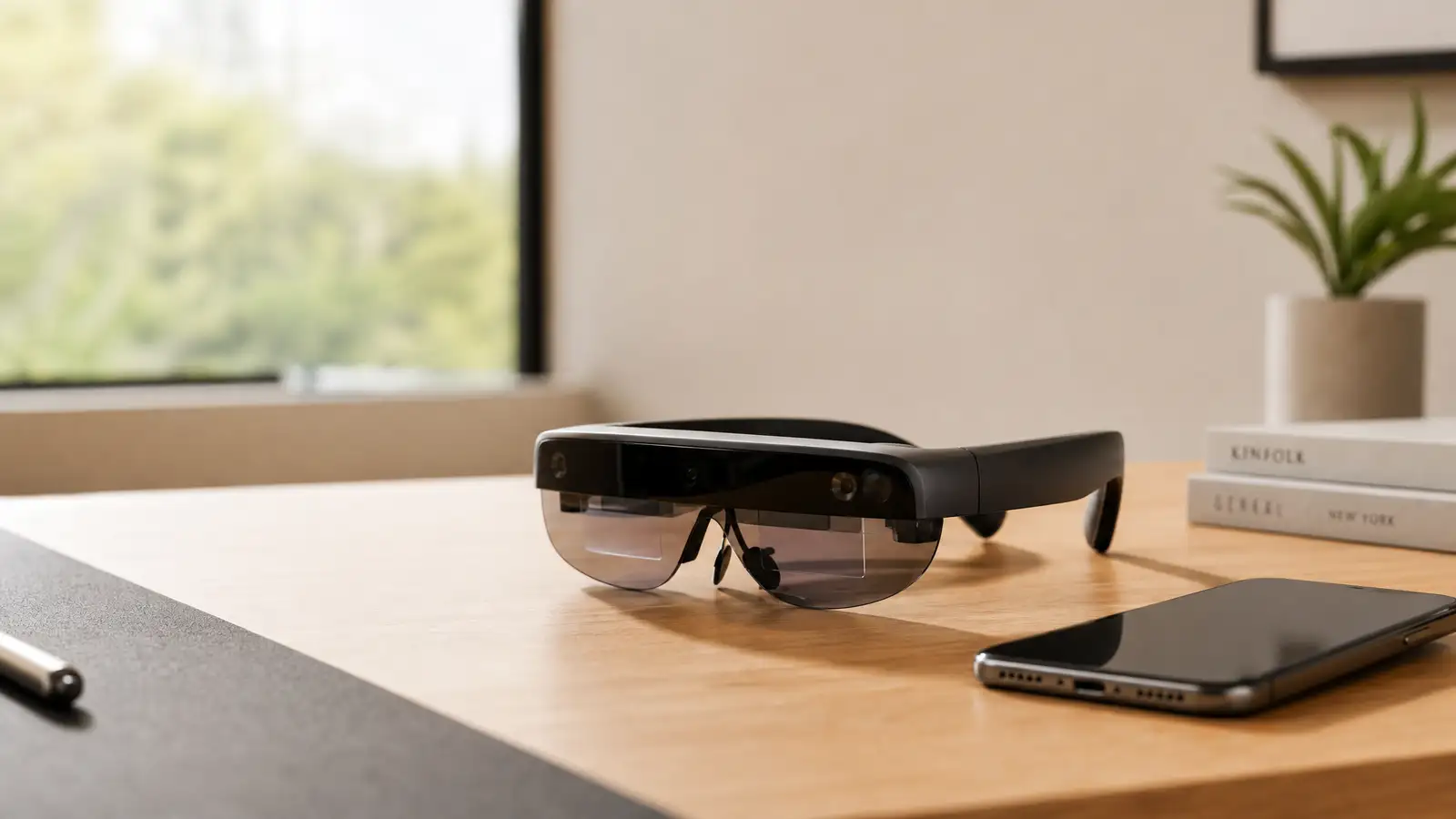
While Meta and Apple maneuver at the high end, XREAL is attacking the price floor. On July 10, the company’s “X by Xreal” sub-brand launched the xbx a01+ internationally at $300, making it the cheapest AR glasses with useful specs to reach Western markets.
For $300, buyers get 50 degrees of field-of-view, HDR10 support with real-time SDR-to-HDR conversion, a 120Hz refresh rate, and 1,600 nits of brightness from Sony micro-OLED displays through bird bath optics. What they do not get: camera sensors, electrochromic dimming, or the “Sound by Bose” audio found in XREAL’s premium models. These omissions are the price of hitting $300, and they reveal XREAL’s calculation about what mainstream buyers need.
The xbx a01+ sits well below XREAL’s premium lineup, which runs from the $400 Xreal One to the $600 Xreal One Pro. The company launched the device in China in May and is now distributing it through xreal.com, Amazon, Best Buy, B&H, and Micro Center, a retail footprint that matches Meta’s.
XREAL is using the playbook that worked for Chinese smartphone makers a decade ago: ship competent hardware at a price that makes premium competitors look indulgent, then iterate upward. If the xbx a01+ sells in volume, it will make $300 the new entry point for AR and force every other player to justify their pricing.
The silicon layer
Beneath all this hardware competition is a quieter battle at the chip level. Qualcomm recently announced the Snapdragon Reality Elite, its new flagship XR chipset, and XREAL confirmed the chip will power the compute puck for its upcoming Xreal Aura glasses, shipping this fall. The Reality Elite represents Qualcomm’s bet that dedicated XR silicon, not repurposed smartphone chips, is necessary for spatial computing devices to deliver acceptable battery life, thermal performance, and on-device AI. Without custom silicon, XR headsets burn through battery running computer vision pipelines on general-purpose processors, which limits both form factor and adoption.
Apple’s silicon advantage with the M-series chips remains substantial, but the company’s retreat from Vision Pro means that advantage is now aimed at smart glasses rather than full headsets. Meta continues to work with Qualcomm on custom variants for Quest devices while building its own silicon capabilities internally.
Three paths forward
The XR hardware market in mid-2026 has crystallized around three competing strategies.
Meta is pursuing breadth: multiple devices at multiple price points, from $299 Quest to premium headsets to smart glasses, all anchored by a software ecosystem that spans fitness, gaming, productivity, and social. The strategy is expensive and requires sustained investment through uncertain adoption curves, but it gives Meta the best shot at owning whatever form factor consumers ultimately choose.
Apple is pursuing focus: accepting that the $3,500-plus headset market cannot support a major product line, redirecting resources to smart glasses, and keeping Vision Pro alive as a halo product rather than a volume play. The third-party controller initiative shows Apple is not abandoning Vision Pro entirely. It is repositioning the device as a professional tool with an accessory ecosystem, more Mac Pro than iPhone.
XREAL is pursuing price: using Chinese manufacturing scale and component trade-offs to push AR glasses below $300, betting that adoption follows affordability the way it did for smartphones. If the xbx a01+ succeeds, it could do for AR what the Moto G did for smartphones in 2013: prove that “good enough” at an accessible price is a bigger market than “great” at a premium one.
HTC is the wildcard. Its pivot to AI glasses and the VIVERSE platform is the strategy of a company that has accepted it cannot win the hardware war but can carve out a niche in software and services. The 1.7 million monthly active users on VIVERSE is not a trivial number, but it is not a defensible moat against Meta, which can replicate platform features and distribute them to an order of magnitude more users.
The next checkpoint for all four companies is Meta Connect on September 23. If Bosworth’s hints translate into hardware announcements, the XR market could look very different by year’s end. What is clear now is that the strategies have diverged permanently. No single vision of XR hardware is winning. The market is big enough for three.