Smart Glasses in 2026: How AR Platforms Are Finally Competing With Smartphones
Analysts expect smart glasses sales to grow fourfold in 2026 compared to last year. Meta alone reported seven million buyers of its Ray-Ban smart glasses in the most recent earnings period. Google demoed its first practical AI-powered glasses at I/O. Apple shipped visionOS 27 with context-aware spatial features. Last year’s visionOS 26 already rewrote the rules of spatial computing, and version 27 pushes further. Snap is preparing lightweight consumer hardware for the first time.
This is not a collection of prototypes. These are shippable products with actual price points and real users. The smart glasses category has crossed from laboratory curiosity to a genuine consumer electronics market.
The Hardware Landscape in 2026
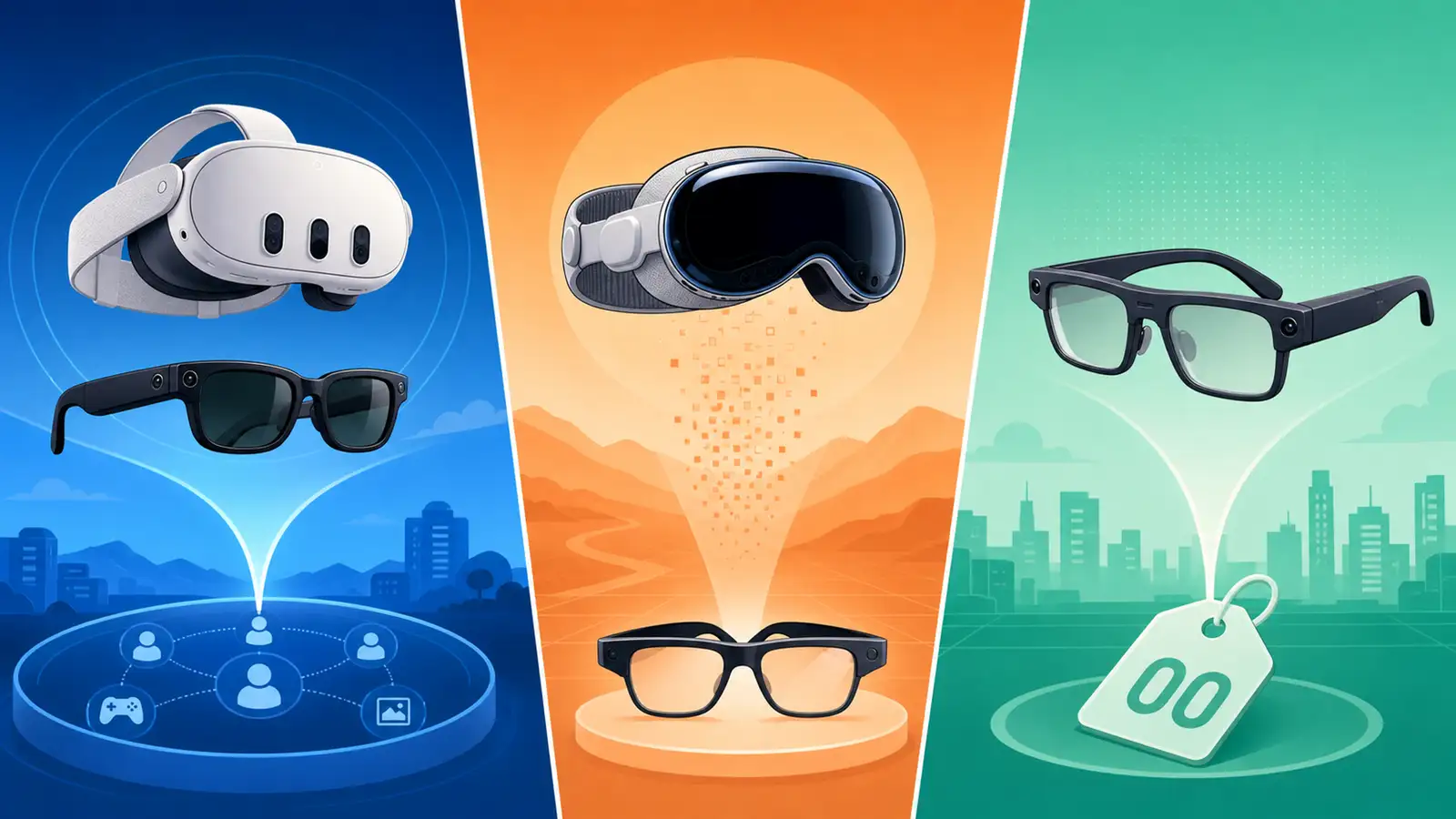
The field has consolidated around five major players, each pursuing a different product philosophy.
Meta Ray-Ban launched its display-equipped models on April 14, 2026, offering prescription-compatible AR displays starting at $499. The partnership with Luxottica gives Meta access to optical retail channels that no other tech company can match. If you want AR glasses that look like ordinary eyewear and cost roughly the same as a premium smartphone, Meta has the most complete product available today.
Google’s Project Aura was demonstrated at Google I/O in May 2026 as a tethered AR system that promises broader application support through the Android XR platform. Google also showed audio-first smart glasses that prioritize voice interaction and subtle visual overlays over full visual displays. This approach makes AR practical for commuters and hands-free situations where pulling out a phone is inconvenient or unsafe.
Apple’s visionOS 27 arrived on June 8, 2026, with a significant Siri upgrade: the assistant now responds based on what you are looking at in your spatial environment. This context-aware capability transforms Siri from a voice assistant into a spatial intelligence layer. It is a software play that leverages Apple’s installed Vision Pro user base while preparing the ecosystem for lighter, glasses-form-factor hardware that Apple has been developing.
Snap has been working on consumer AR glasses for years through its Spectacles line, but 2026 marks the company’s first serious push toward mainstream pricing and form factor. Snap’s advantage lies in its creator ecosystem and Lens Studio platform, which already powers millions of AR experiences on smartphones. Porting that capability to dedicated glasses hardware gives Snap a content library that no competitor can replicate quickly.
Xreal plans to launch its consumer AR devices commercially in 2026, targeting the segment of users who want large virtual screens without carrying a physical monitor or laptop. Viture has similarly pushed hardware upgrades with its Beast line. Samsung has also been testing its own AR glasses in the spatial computing race, though its product remains further from consumer release than Meta’s or Google’s.
The Numbers That Define the Market
| Metric | Value | Source |
|---|---|---|
| Projected smart glasses sales growth (2026 vs 2025) | 4x increase | Industry analyst consensus |
| Meta Ray-Ban smart glasses buyers | 7 million | Meta earnings report |
| Meta Ray-Ban entry price (display models) | $499 | Product launch, April 2026 |
| visionOS 27 release date | June 8, 2026 | Apple developer update |
| Google I/O AR demos | May 2026 | Google developer conference |
The fourfold growth projection reflects a market that has solved its two biggest historical problems: form factor and price. Early AR headsets were heavy, expensive, and socially awkward to wear. The current generation of smart glasses addresses all three by borrowing design language from the optical industry and leveraging advances in micro-display technology.
What Changed This Year
Three technical developments made 2026 the inflection point.
Hardware miniaturization has reached a point where AR displays, processors, and batteries fit into frames that are visually indistinguishable from regular glasses. The micro-OLED and waveguide display technologies that were experimental three years ago are now in mass production.
Google’s Android XR platform provides a shared software foundation that developers can target across multiple hardware manufacturers. Before Android XR, every AR device required a custom app development pipeline. Now there is a standard platform, similar to how Android standardized smartphone app development.
The AI integration layer is the third piece. Every major smart glasses platform now incorporates on-device AI for real-time translation, contextual information retrieval, and voice interaction. This is not a gimmick. It is the core use case that makes a pair of glasses more useful than a phone for specific tasks like navigation, translation, and real-time information lookup.
How These Platforms Compare to Smartphones
Smart glasses will not replace phones entirely in 2026. But they are beginning to handle specific use cases better than phones do.
Navigation is the most obvious example. Turn-by-turn directions displayed directly in your field of view are safer and more convenient than glancing down at a phone screen while walking or cycling. Both Meta and Google have demonstrated this capability with their latest hardware.
Real-time translation is another area where smart glasses have a natural advantage. Seeing translated text overlaid on a menu, sign, or document eliminates the friction of pulling out a phone, opening an app, and pointing a camera.
Private screen replacement is the third category. Xreal and Viture both offer products that project a large virtual display visible only to the wearer. For travelers, remote workers, and anyone who wants a second screen without carrying a physical monitor, this is a genuinely useful capability.
The phone remains superior for content creation, extended reading, and any task that requires precise touch input. But smart glasses are carving out a complementary role: ambient computing that provides information and interaction without requiring you to look at a screen.
The Developer Ecosystem
Hardware is only half the story. The platform that wins the smart glasses race will be the one with the strongest developer ecosystem.
Google’s Android XR gives developers a familiar target with established tooling and distribution through the Google Play ecosystem. Meta is building on its existing Reality Labs developer community, which already supports Quest VR applications. Apple’s visionOS benefits from the existing iOS developer base and the App Store distribution model. Snap’s Lens Studio provides web-based AR creation tools that require minimal programming knowledge.
The diversity of development approaches means that 2026 will see a wide range of experimental applications hit the market. Some will succeed. Most will not. But the presence of multiple platforms ensures that competition will drive rapid improvement.
Privacy Considerations
Smart glasses with cameras and always-on microphones raise legitimate privacy concerns that the industry has not fully addressed. Meta’s Ray-Ban glasses include a visible recording indicator light, but the effectiveness of this approach depends on user compliance and awareness.
Google’s audio-first approach partially sidesteps this issue by minimizing visual recording capability, but voice interaction still involves continuous microphone monitoring. Snap’s consumer glasses will face the same scrutiny that its Spectacles line encountered during their original launch.
These concerns will not stop the market from growing. But they will shape regulatory responses and product design choices in the years ahead. Companies that build privacy-respecting features — clear recording indicators, local processing over cloud streaming, and user-controllable data policies — will have an advantage in markets with strict privacy regulations.
What to Watch Next
The second half of 2026 will likely bring the first wave of independent app reviews and real-world user testing data for these platforms. That data will tell us more about adoption patterns than any analyst projection.
Apple’s next hardware announcement will reveal whether the company is preparing a glasses-form-factor device or doubling down on the headset form factor with Vision Pro. Google’s Project Aura timeline for consumer availability will signal whether the company views AR as a near-term product category or a long-term bet.
Meta’s next earnings call will provide updated Ray-Ban sales figures that indicate whether the April launch drove sustained demand or a temporary spike. And Snap’s consumer hardware reveal will show whether the company is competing on price, features, or both.
The smart glasses market in 2026 is not about which device is the most technologically impressive. It is about which platform can make augmented reality feel like a natural extension of how people already interact with information.
Sources: Glass Almanac — 7 Smart Glasses Platforms in 2026, Glass Almanac — 6 AR Announcements in 2026, Glass Almanac — Top 7 AR Moves in 2026