Salesforce's $3.6 Billion Fin Acquisition Signals the Next Phase of the AI Agent Economy
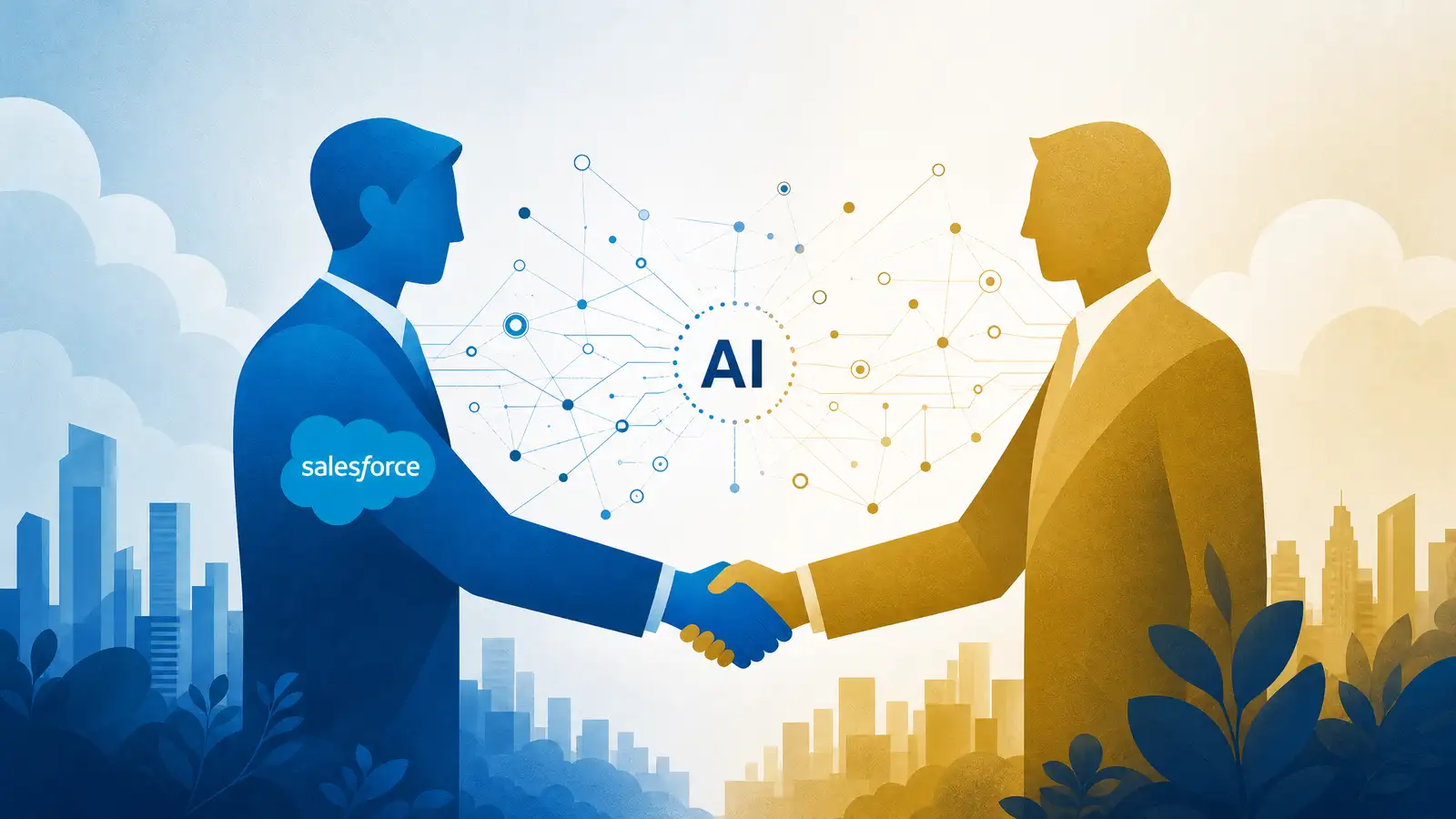
Salesforce announced this week that it will acquire Fin, an AI agent platform, for approximately $3.6 billion, according to Reuters. The deal is one of the largest AI-agent-focused acquisitions of 2026 and one of the clearest signals yet that enterprise software companies are no longer treating autonomous agents as an experimental feature — they are treating them as the next revenue platform.
Fin specializes in building AI agents for customer service workflows. Unlike chatbots, which respond to individual prompts, Fin’s agents can handle multi-step tasks: pulling customer data from a CRM, checking order history, processing a return, and sending a confirmation email, all without human intervention. That capability is exactly what Salesforce wants to embed across its own platform, where millions of customer service representatives already spend their days navigating ticket queues.
The price tag — $3.6 billion — is notable. It puts Fin in the same acquisition tier as Anthropic’s early funding rounds and suggests that Salesforce views AI agent infrastructure as strategically comparable to large language model development itself.
Why Customer Service Is the First Beachhead
Customer service is the most obvious target for autonomous AI agents, and the reasons go beyond cost savings:
Structured workflows. Customer service follows predictable patterns. A customer has a problem, the agent follows a decision tree to resolve it, and the interaction ends with a resolution or escalation. This structure maps cleanly onto AI agent architectures, which excel at multi-step reasoning within bounded domains.
High volume, repetitive tasks. The average customer service representative handles dozens of similar queries per day — password resets, shipping updates, return requests. These are precisely the tasks that AI agents can automate with minimal customization.
Existing data infrastructure. Salesforce already owns the customer data. Fin’s agents need access to CRM records, order histories, and communication logs to function. When both the data and the agent platform live within the same company, the integration becomes significantly easier.
The Bigger Picture: AI Agent Infrastructure Is the New Cloud
The Salesforce-Fin deal is part of a broader pattern that has been building throughout 2026. Several developments point in the same direction:
Loop engineering. Forbes reported this week on the emerging practice of “loop engineering” — designing AI systems that perform iterative tasks until a specified condition is met, rather than responding to single prompts and stopping. This represents a shift from conversational AI to operational AI. Instead of asking an AI a question and acting on its answer, you give it a goal and let it work through the steps autonomously.
Security concerns are catching up. The Hacker News disclosed this month that LangGraph, one of the most popular AI agent frameworks, had three security flaws including a critical remote code execution vulnerability chain. The flaws have been patched, but the disclosure highlights a pattern: AI agent infrastructure is moving faster than the security practices designed to protect it.
Medical AI agents are entering production. Nature published research on MIRA, an autonomous AI agent that operates within a sandboxed electronic health records environment to obtain patient histories, order and interpret lab tests, and generate treatment recommendations. This is not a prototype — it is a system being tested in real clinical settings.
Together, these developments suggest that 2026 is the year AI agents transition from “interesting demo” to “enterprise infrastructure.” Salesforce’s $3.6 billion investment is not a bet that AI agents might become important. It is a bet that they already are.
What This Means for the AI Agent Market
The acquisition has implications beyond Salesforce and Fin:
Valuation benchmarks. A $3.6 billion price tag for an AI agent platform sets a reference point for the rest of the market. Other AI agent startups — particularly those focused on vertical use cases like healthcare, finance, or legal services — will now benchmark their own valuations against Fin’s exit.
Competition for talent and technology. Salesforce is not the only enterprise software company looking at AI agent acquisitions. Microsoft, Oracle, and SAP all have customer-facing platforms that could benefit from autonomous agent integration. The companies that move fastest will have a structural advantage in building the next generation of enterprise software.
The integration challenge. Acquiring the technology is the easy part. Embedding Fin’s agent capabilities into Salesforce’s existing product suite — Sales Cloud, Service Cloud, Marketing Cloud — without disrupting the workflows of millions of existing users is a massive engineering challenge. The companies that have tried similar large-scale AI integrations (Google with DeepMind, Microsoft with OpenAI) have all found that acquisition is the beginning, not the end, of the story.
The Loop Engineering Angle
The concept of loop engineering, highlighted by Forbes this week, is worth understanding because it explains what makes AI agents different from every previous generation of automation.
Traditional automation follows a script: if X happens, do Y. AI agents using loop engineering follow a goal: achieve Z, using whatever sequence of steps is necessary, checking conditions as you go. This is the difference between a macro that fills in a form and an agent that figures out what form needs to be filled in, finds the right data, fills it in, checks for errors, and resubmits if needed.
Fin’s platform is built on this loop-based architecture. Salesforce is not buying a chatbot company — it is buying a goal-directed automation engine that can operate across its entire product ecosystem.
The Security Problem Nobody Is Talking About
LangGraph’s vulnerability disclosure this month is a reminder that AI agent infrastructure has unique security properties that traditional software does not.
When you give an AI agent the ability to perform multi-step tasks autonomously, you are also giving it the ability to perform multi-step tasks that its developer did not anticipate. The LangGraph flaws allowed attackers to exploit SQL injection vulnerabilities that chained together into remote code execution. In an AI agent context, the attack surface is even larger because agents are designed to interact with multiple systems — databases, APIs, file systems — as part of their normal operation.
As AI agents become more capable and more widely deployed, the security implications will become a defining factor in which platforms survive and which ones face existential crises. The Salesforce-Fin deal assumes that Fin’s agent technology is secure enough to integrate into one of the world’s largest enterprise platforms. That assumption will be tested at scale.
What to Watch
Three things will determine whether this acquisition pays off:
Integration speed. If Salesforce can ship Fin-powered agent features across its product suite within 12 months, the acquisition looks prescient. If it takes two or three years, competitors will have caught up and the technology advantage will have eroded.
Customer adoption. Enterprise customers are skeptical of AI features that sound impressive but disrupt their existing workflows. Fin’s agents need to integrate seamlessly into Salesforce’s existing interface, not replace it.
The next acquisition. If Salesforce can make Fin work, expect other enterprise software companies to follow with their own AI agent acquisitions. The companies that sit on the sidelines for too long will find themselves competing against platforms that have autonomous capabilities baked in rather than bolted on.
The $3.6 billion price tag is high. But if AI agents become the default way that enterprise software interacts with customers, employees, and data, it might end up looking like a bargain.
Related Articles