AWS Just Gave Enterprise AI Agents a Major Upgrade — and It Changes How Companies Deploy Autonomous Systems
Amazon Web Services announced a new suite of tools on Monday aimed at making enterprise AI agents more effective in production environments. The announcement comes at a moment when the broader industry is experiencing a convergence of related developments: AI agents are being integrated directly into enterprise applications as decision-making systems, major business publications are calling for multi-model agent architectures, and this week’s CCW 2026 conference made it clear that autonomous agents have moved beyond the pilot phase entirely.
Taken together, these signals paint a picture of an industry crossing a threshold. AI agents are no longer experimental curiosities or proof-of-concept demos. They are becoming the infrastructure layer that sits between enterprise software and the humans who use it.
What AWS Is Building
AWS’s new tooling focuses on the specific problems that emerge when organizations try to deploy AI agents at scale. The challenges are not about model capability — the models are capable. The challenges are about reliability, security, observability, and integration.
AWS is addressing these problems with tools that provide:
Agent lifecycle management. Building, testing, and deploying AI agents follows a different workflow than traditional software. AWS’s new tools include capabilities for agent versioning, A/B testing of agent behaviors, and rollback mechanisms when an agent’s decision patterns drift outside acceptable parameters.
Enhanced observability and tracing. When an AI agent makes a decision that affects a business outcome — approving a loan, rerouting a supply chain shipment, escalating a customer complaint — enterprises need to understand why. AWS is introducing deeper tracing capabilities that log not just the agent’s final action but the reasoning chain that led to it, including which tools it invoked, what data it retrieved, and what constraints it evaluated.
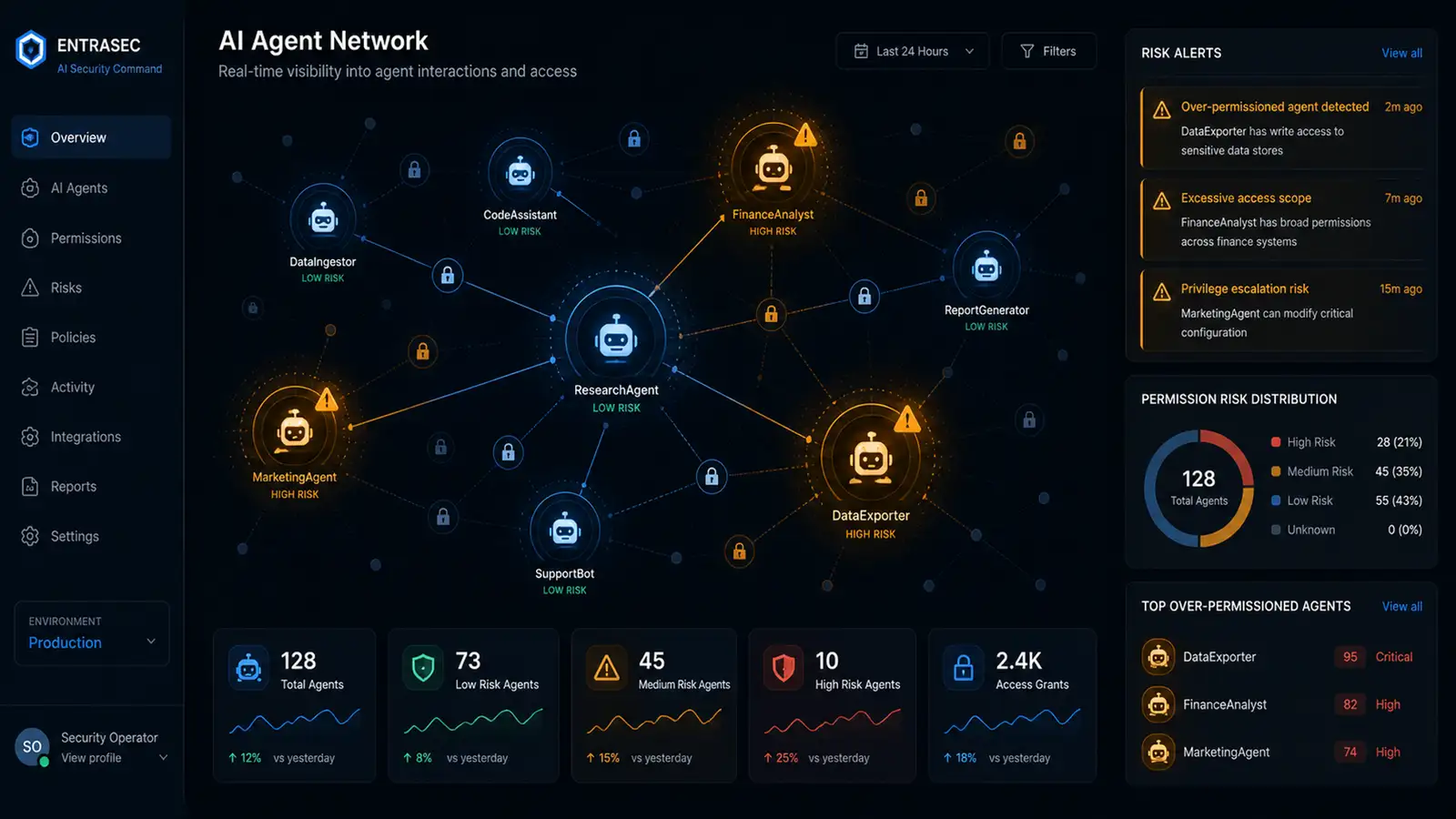
Improved security guardrails. The most critical addition is a set of policy enforcement tools that let administrators define what actions an agent is permitted to take, what data sources it can access, and what escalation paths must be triggered when the agent encounters uncertainty. This is a direct response to a pattern that has emerged across the industry: AI agents deployed without sufficient guardrails tend to overreach, accessing systems or performing actions that their developers did not intend.
Integration with existing enterprise data. AWS is also making it easier for agents to connect to the data sources that enterprises already use — ERP systems, CRM platforms, data warehouses — without requiring custom integration code for each connection. This is significant because the primary bottleneck for enterprise AI agent adoption has not been intelligence; it has been data access.
The Decision System Shift
The AWS announcement aligns with a broader trend that CIO.com highlighted this week: AI agents are turning enterprise applications into decision systems rather than record-keeping tools.
Traditional enterprise software is designed to store data and present it to humans who make decisions. A salesperson reviews customer records and decides how to price a deal. A supply chain manager reviews inventory reports and decides what to reorder. The software provides information; humans provide judgment.
AI agents invert this model. They receive a goal — maximize margin on this deal, minimize stockouts in this region — and then autonomously work through the steps needed to achieve it. They query data, evaluate options, execute actions, and report outcomes. The human moves from operator to supervisor.
This shift has profound implications for how enterprise software is designed. If agents are the primary users of your application, the interface matters less than the API. The data model matters more than the dashboard. And the ability to handle edge cases — the situations where the agent’s automated reasoning fails — becomes the most important feature in the product.
Multi-Model Agent Teams
Harvard Business Review published an important piece this week arguing that the strongest AI agent teams will be built using different models for different tasks. This is a departure from the prevailing assumption that a single, increasingly capable model will eventually handle everything.
The argument is straightforward: different models have different strengths. One model may excel at reasoning through complex logical problems but struggle with creative writing. Another may be excellent at code generation but weak at numerical analysis. By orchestrating multiple models within a single agent workflow — routing each subtask to the model best suited for it — organizations can achieve better outcomes than any single model could provide.
AWS’s new tooling supports this multi-model approach by providing the infrastructure needed to route tasks between models, aggregate results, and maintain consistency across the agent’s overall behavior.
This is a recognition that the future of enterprise AI is not a single supermodel. It is a team of specialized models, coordinated by an orchestration layer, working together to solve problems that no individual model could handle alone.
Beyond Pilots: The CCW 2026 Signal
The CCW 2026 conference, covered by CMSWire this week, delivered a clear message: AI agents are done piloting. The organizations presenting at the conference were not talking about proof-of-concept projects or limited trials. They were reporting on agents handling thousands of customer interactions daily, agents managing supply chain operations across multiple regions, and agents performing financial analysis that previously required teams of human analysts.
This is the most significant signal in the entire landscape. When a major enterprise conference shifts from “how do we pilot AI agents?” to “how do we scale and manage the AI agents we already depend on?” it means the technology has crossed from early adoption into mainstream deployment.
The Observability Imperative
One of the most significant but least discussed challenges in enterprise AI agent deployment is observability. When a traditional software system fails, engineers can trace the execution path through logs, identify the line of code that caused the error, and fix it. When an AI agent fails — making a decision that seems reasonable given the data it had available but produces a harmful outcome — the debugging process is fundamentally different.
AWS’s new tracing capabilities directly address this challenge by providing what amounts to a flight data recorder for AI agents. Every decision point, every tool invocation, every piece of data accessed is logged with enough context that a human reviewer can reconstruct the agent’s reasoning after the fact. This is not just useful for debugging. It is essential for regulatory compliance, for building trust with customers who interact with agents, and for the continuous improvement of agent behavior over time.
Without this level of observability, organizations are essentially flying blind. They know that agents are making decisions, but they cannot explain why. In regulated industries — finance, healthcare, government — this is not acceptable. AWS’s investment in tracing infrastructure recognizes that explainability is not a nice-to-have feature for enterprise AI. It is a prerequisite.
The Integration Challenge
Even the most capable AI agent is useless if it cannot access the data it needs to operate. This is why AWS’s work on simplifying enterprise data integration may be the most impactful part of the announcement. Connecting an AI agent to an SAP ERP system, a Salesforce CRM, a Snowflake data warehouse, and an internal document management system is not trivial. Each connection requires authentication, data mapping, access control, and error handling. And when one of these systems changes its API — which happens frequently in enterprise environments — the agent’s connection breaks.
By providing a more standardized integration layer, AWS is reducing the custom engineering effort required to connect agents to enterprise data. This is particularly important for mid-market companies that do not have the engineering resources to build and maintain dozens of custom integrations. The democratization of enterprise AI agent deployment will come not from better models but from easier integrations.
What This Means for Organizations
For companies considering AI agent adoption, the landscape is clearer than it has ever been:
Infrastructure is maturing. AWS, Microsoft, and Google are all investing heavily in the tooling needed to deploy agents reliably. The barrier to entry is falling. Organizations that waited for the infrastructure to stabilize are finding that it already has.
Security cannot be an afterthought. The LangGraph vulnerability disclosed earlier this year — three security flaws including a critical remote code execution chain — demonstrated that AI agent infrastructure moves faster than security practices. The guardrail tools that AWS is introducing are necessary but not sufficient. Organizations need to build security into their agent workflows from the start.
Multi-model is the way forward. The HBR analysis is persuasive: organizations that try to build everything on a single model will eventually hit limitations that a multi-model architecture would have avoided. The companies that adopt a multi-model approach early will have a structural advantage.
Observability is non-negotiable. The ability to explain and audit agent decisions is not optional for enterprise deployments. Organizations need tracing, logging, and review capabilities built into their agent workflows from day one.
The human role is changing, not disappearing. As agents take over more operational decisions, humans shift from operators to supervisors. This requires a different skill set — understanding agent behavior, setting appropriate goals and constraints, recognizing when an agent needs intervention — that organizations will need to develop through training and experience.
Integration is the real bottleneck. Agent capability is no longer the limiting factor. The challenge is connecting agents to the data systems they need to operate effectively. Tools that simplify these connections will have outsized impact on adoption rates.
The Road Ahead
AWS’s new tools are a significant step forward for enterprise AI agents. They address the real problems that organizations face when moving agents from demonstration to deployment. But they are just one piece of a larger transformation.
The convergence of improved tooling, multi-model architectures, enterprise integration, and production-scale deployments suggests that 2026 will be remembered as the year AI agents became enterprise infrastructure. The companies that recognize this shift and invest accordingly will have a significant advantage over those that continue to treat agents as experimental technology.
The question is no longer whether AI agents will transform enterprise operations. The question is which organizations will build the infrastructure to manage them effectively.