VR Is Quietly Transforming Medical Training — and Saving Lives in the Process
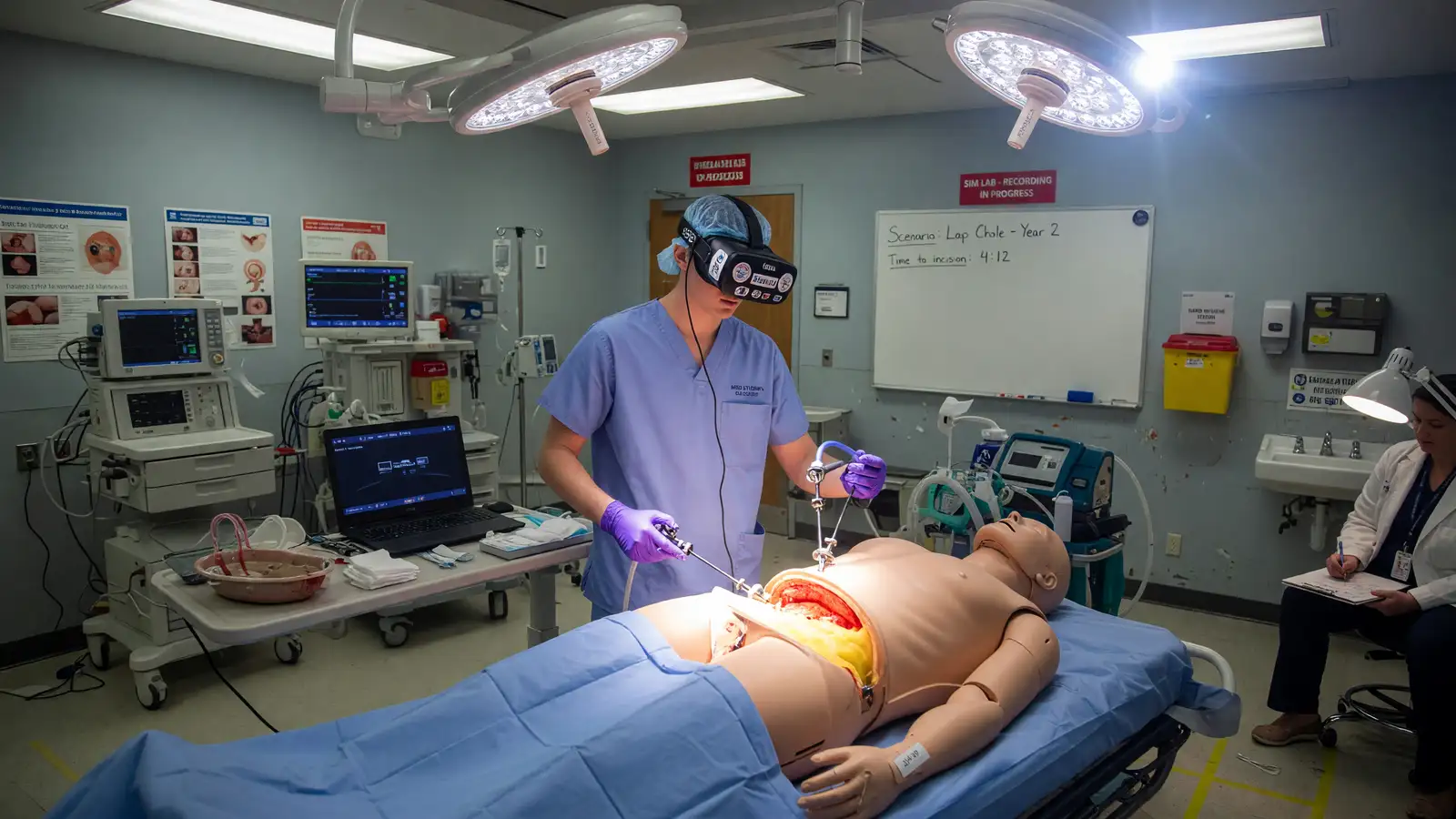
While the consumer metaverse has struggled to find its footing, virtual reality has been quietly revolutionizing medical training — a domain where the technology’s ability to provide realistic, repeatable, risk-free practice translates directly into improved patient outcomes. The evidence is now strong enough that VR medical training is transitioning from optional supplement to essential infrastructure in medical education.
The Evidence for VR Medical Training
The research on VR surgical training is unusually robust for an educational technology. Multiple randomized controlled trials have demonstrated that surgeons who train on VR simulators perform procedures faster, with fewer errors, and with better outcomes than those who train through traditional methods alone. The effect is particularly strong for laparoscopic and endoscopic procedures, where the hand-eye coordination and spatial reasoning skills that VR training develops map directly to the operating room.
The mechanism is straightforward: VR provides deliberate practice — the focused, repetitive, feedback-rich training that research consistently shows is the most effective way to develop complex skills. A surgical resident can perform a virtual procedure dozens of times, receiving immediate feedback on technique, before ever touching a patient. This volume of practice, with this quality of feedback, is simply not possible with traditional training methods that depend on the availability of cadavers, animal models, or supervised live procedures.
Beyond Surgery
VR medical training is expanding beyond surgery into domains where the technology’s unique capabilities provide value that traditional training methods cannot match. Emergency medicine training — where rare, high-stakes scenarios must be practiced until responses become automatic — is a natural fit. A VR simulation can expose trainees to a wider variety of emergency scenarios, with greater frequency and consistency, than they would encounter in years of clinical rotations.
Patient communication training — practicing difficult conversations about diagnosis, treatment options, and end-of-life care — benefits from VR’s ability to create realistic, emotionally engaging interactions with virtual patients. The emotional learning that occurs in these simulations transfers to real clinical encounters in ways that traditional role-playing exercises with fellow trainees do not match.
Anatomy education — traditionally dependent on cadavers, which are expensive, limited in supply, and restricted to single-use — is being transformed by VR models that allow students to explore anatomical structures from any angle, at any scale, with layers that can be added or removed at will. The educational effectiveness of VR anatomy instruction now rivals or exceeds cadaver-based instruction at a fraction of the cost.
The Scaling Challenge
The barrier to broader VR medical training adoption is not effectiveness — the evidence is clear — but implementation. VR hardware requires investment. Curriculum needs to be developed or licensed. Faculty need to be trained. Technical support needs to be available. These are not insurmountable barriers, but they are real, and they explain why VR medical training adoption has been slower than the evidence would suggest is optimal.
The healthcare systems and medical schools that are investing in VR training infrastructure are making a bet that the clinical outcomes improvement — fewer surgical complications, better emergency response, more effective patient communication — will justify the investment many times over. Given the evidence, it is a bet with favorable odds. The question is not whether VR will become standard in medical training, but how quickly — and how many patients will benefit from better-trained clinicians in the meantime.