The Race to Build a Quantum Internet Is Heating Up
The quantum internet — a network that transmits quantum information rather than classical bits — has been described as the ultimate expression of quantum networking technology. It would enable unconditionally secure communication, distributed quantum computing, and quantum sensor networks with capabilities that no classical network can match. While a full quantum internet remains years away, progress on its fundamental components is accelerating, and the pieces are beginning to fall into place.
The Building Blocks
A quantum internet requires several technologies that do not yet exist at scale. Entanglement distribution — the ability to create and maintain quantum entanglement between distant nodes — is the most fundamental. Entanglement is the quantum mechanical phenomenon that Einstein called “spooky action at a distance”: two particles become correlated in such a way that measuring one instantaneously determines the state of the other, regardless of the distance between them. A quantum internet would use entanglement as its basic communication resource, analogous to the electromagnetic signals that carry information in a classical network.
Quantum repeaters are the second essential component. Quantum signals, like classical signals, degrade over distance. In classical networks, repeaters amplify the signal. In quantum networks, the situation is more complicated — quantum information cannot be amplified without destroying it (the “no-cloning theorem”). Quantum repeaters must therefore use more sophisticated techniques — entanglement swapping and purification — to extend the range of quantum communication without destroying the quantum information.
Quantum memory — the ability to store quantum information for extended periods — is the third critical component. Quantum signals travel at the speed of light, but quantum processing is not instantaneous. Quantum memory provides the buffer that allows quantum information to be stored at intermediate nodes while entanglement is established and processing is completed.
Recent Progress
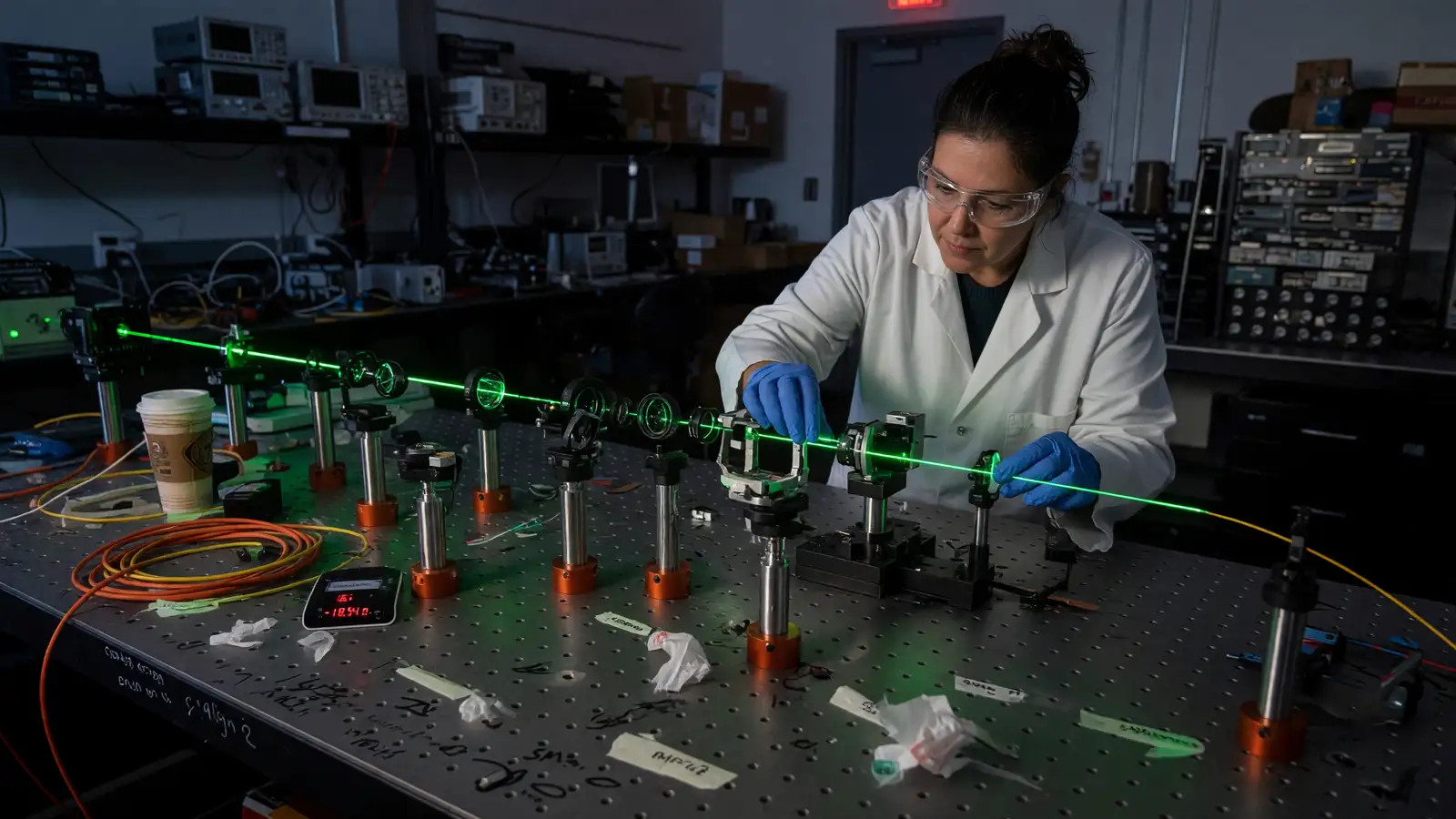
Recent progress on all three components has been encouraging. China Mobile Research Institute’s demonstration of 5-qubit entanglement with 95.6% fidelity using integrated photonics is a step toward practical entanglement distribution at room temperature. Several research groups have demonstrated quantum repeaters that extend entanglement range beyond the fundamental limits of direct transmission. Quantum memory coherence times — how long quantum information can be stored before it degrades — have improved dramatically, from microseconds to milliseconds and, in some systems, seconds.
The integration of these components into working prototypes is the next step. Several national and international initiatives — the US Department of Energy’s quantum internet blueprint, the European Quantum Internet Alliance, China’s quantum communication satellite program — are working toward integrated demonstrations that combine entanglement distribution, quantum repeaters, and quantum memory into functional quantum network nodes.
The Applications
The initial applications of a quantum internet would likely focus on secure communication. Quantum key distribution (QKD) — using quantum mechanical principles to generate encryption keys that are theoretically impossible to intercept without detection — is the most mature quantum networking application and would be the first to benefit from quantum internet infrastructure.
Distributed quantum computing — connecting multiple quantum processors over a quantum network to create a virtual quantum computer larger than any single processor — is the most transformative potential application. It would allow quantum computers to scale beyond the physical constraints of individual devices, potentially accelerating the timeline for solving commercially relevant problems.
Distributed quantum sensing — networks of quantum sensors that collectively achieve sensitivity far beyond individual sensors — could transform fields from gravitational wave detection to environmental monitoring to defense. The sensitivity improvement from networking quantum sensors scales quadratically with the number of nodes, meaning a network of even modest size could dramatically outperform the best individual sensors.
The quantum internet is often discussed as if it is a distant future technology — something for the 2030s or beyond. But the component technologies are advancing on timelines that suggest practical quantum networking may arrive sooner. The race to build the quantum internet is not a sprint, but it is accelerating faster than most observers expected.