NVIDIA's Three-Computer Architecture Is Building the Digital Brain of Manufacturing
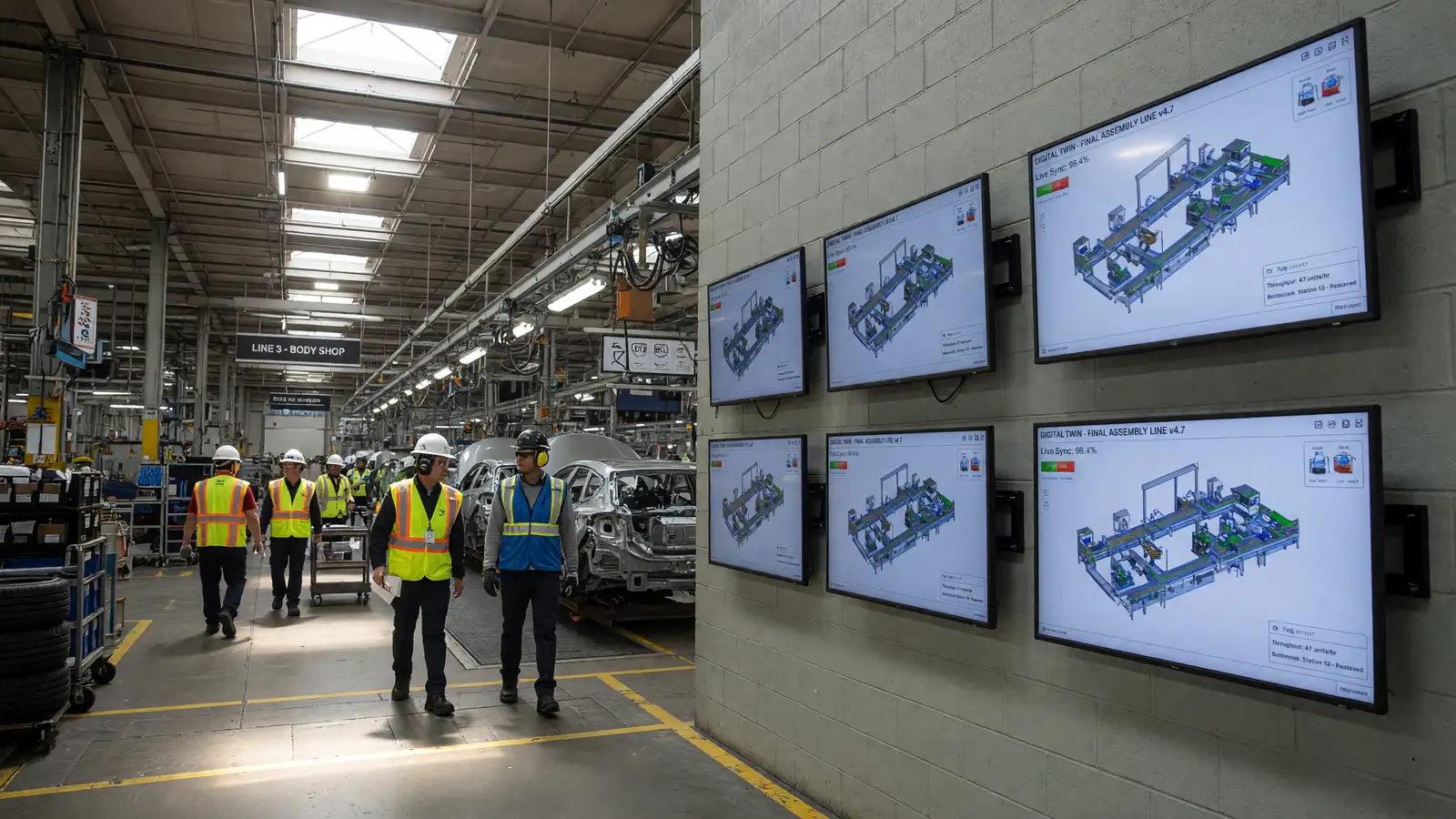
NVIDIA has spent the better part of a decade positioning itself as more than a GPU company. With the formalization of its three-computer architecture — a framework combining AI training, physics-accurate simulation, and real-time digital twin rendering — the company now offers manufacturers a unified stack for building what it calls the “digital brain” of modern production. Early adopters like Cooler Master are demonstrating the vision works outside of PowerPoint.
The Three Computers Explained
NVIDIA’s architecture divides the computational workload of industrial AI into three domains. The AI computer handles training and inference — where models learn to recognize patterns in sensor data, predict equipment failures, and optimize production parameters. It runs on DGX systems purpose-built for large-scale AI workloads. The simulation computer runs physics-accurate models of the production environment on Omniverse, where engineers test changes to production lines, simulate robot movements, and validate new processes in a risk-free virtual environment. The real-time computer renders the digital twin — the live, interactive 3D representation operators use to monitor and control production — on RTX GPUs delivering low-latency visualization.
Cooler Master as Proof of Concept
Cooler Master, the Taiwanese computer hardware manufacturer, has emerged as one of the most ambitious early adopters. In partnership with Spingence, an AI solutions provider, Cooler Master announced a global AI manufacturing initiative in June 2026 implementing NVIDIA’s framework across its multinational production network. The initiative aims to create a “multinational digital brain” — connected digital twins spanning Cooler Master’s Asian factories that share learnings, optimize production globally, and respond to supply chain disruptions with coordinated adjustments across locations. When a quality issue is detected at one factory, the digital brain instantly propagates corrective action to every facility running the same production line — turning local learning into global improvement.
Why This Matters for Manufacturing Competitiveness
The economic logic rests on three pillars. Speed to insight: traditional optimization relies on physical trial and error with cycles taking hours or days — digital twin simulation compresses this to minutes. Risk-free experimentation: the most valuable improvements involve changes too risky to test on live equipment. Cross-facility learning: when an AI model trained on one factory’s data detects a failure pattern, that model deploys to every factory running similar equipment, multiplying the value of each learning event.
The Competitive Implications
Manufacturers implementing comprehensive digital twin capabilities will operate with structural advantage. Compounding effects of faster learning cycles, broader experimentation, and cross-facility knowledge sharing could create winner-take-most dynamics in segments where margins are thin. For NVIDIA, the architecture represents a bet that the industrial metaverse — not gaming or cryptocurrency — will drive the next wave of GPU demand. The digital brain of manufacturing is under construction.