Metaverse Interoperability in 2026: Why Open Standards Are the Key to a Connected Virtual Future
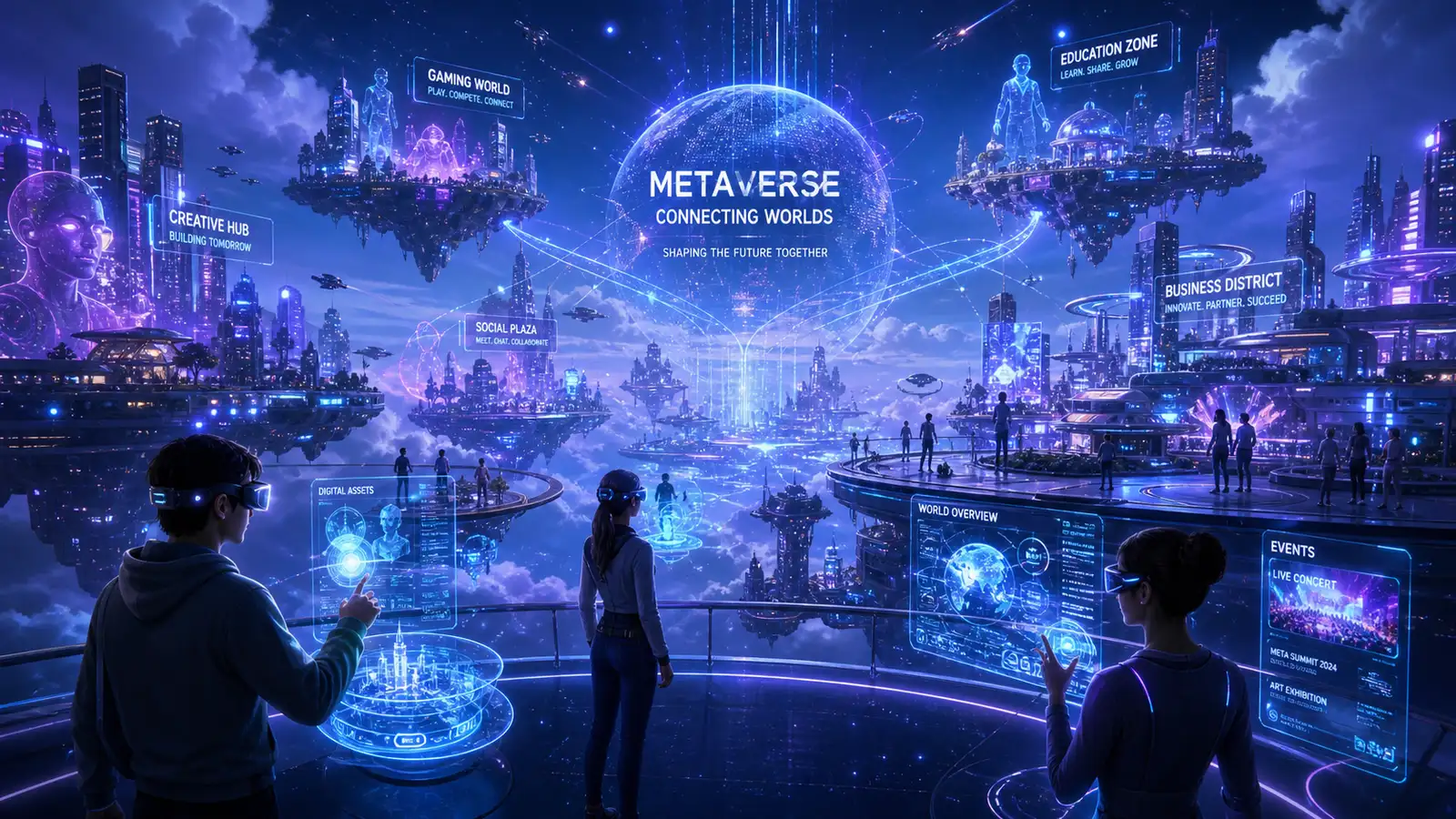
The metaverse has always been sold as a singular destination — one vast, persistent digital universe where people could work, socialize, create, and explore without friction. But the reality in mid-2026 looks very different. The metaverse, as it currently exists, is not a universe at all. It is an archipelago of isolated islands, each built by a different company, each with its own economy, identity system, avatar format, and content standards. Moving between them is not like stepping through a door; it is like starting over from scratch.
This fragmentation is the single biggest obstacle to the metaverse reaching the scale and cultural relevance its proponents envisioned. And in 2026, the industry is finally beginning to address it in earnest.
The Interoperability Problem
To understand why interoperability matters, consider the current user experience. A digital artist who builds a reputation and inventory on one platform — say, a detailed virtual gallery with custom avatars, wearable assets, and a established follower base — cannot take any of that to another platform. Their identity does not transfer. Their assets do not translate. Their social graph does not follow. Each platform is a self-contained economy with a hard border.
This is not merely an inconvenience; it is a structural barrier to the network effects that make digital platforms valuable. The early internet faced a similar challenge in the 1980s and 1990s, when competing networking protocols created isolated digital communities. The solution was the adoption of open standards — TCP/IP, HTTP, HTML — that allowed any compliant system to communicate with any other. The metaverse industry now faces the same inflection point.
The economic stakes are enormous. Analysts at McKinsey estimated the metaverse economy could reach $5 trillion by 2030, but that projection assumes a connected ecosystem. If platforms remain siloed, the addressable market shrinks dramatically because users cannot justify the investment required to build presence and identity across multiple incompatible environments.
The Standards Bodies Leading the Charge
Several organizations have emerged as key players in the push for metaverse interoperability, and 2026 has seen meaningful progress from each.
The Metaverse Standards Forum
Founded in 2022 by the Linux Foundation and the Khronos Group, the Metaverse Standards Forum (MSF) has grown to over 2,400 member organizations, including major technology companies, academic institutions, and standards bodies. In early 2026, the MSF published its Open Metaverse Interoperability Profile (OMIP) 2.0, a comprehensive specification covering avatar representation, asset portability, and identity federation.
The OMIP 2.0 specification is significant because it represents a rare area of consensus among competitors. Meta, Sony, Epic Games, and Microsoft — companies that have every incentive to keep users within their own ecosystems — have all contributed to and endorsed the standard. This does not mean they have opened their walls entirely, but it does mean they have agreed on a common language for the things that cross those walls.
Khronos Group’s OpenXR
The OpenXR standard, which defines a common API for accessing virtual and augmented reality hardware, has reached a critical milestone in 2026. Version 1.1, released in the first quarter of the year, introduces standardized extensions for hand tracking, eye tracking, and spatial mapping that are now supported by all major VR headset manufacturers. This means developers can write applications once and deploy them across Quest, PlayStation VR, Apple Vision Pro, and PC-based headsets without platform-specific code.
The practical impact is substantial. Before OpenXR, a VR application targeting multiple platforms required separate codebases for each SDK — a costly duplication that discouraged smaller developers from entering the market. OpenXR has lowered this barrier, and the result has been a noticeable increase in the diversity and quality of cross-platform XR content.
W3C’s Immersive Web Community Group
The World Wide Web Consortium’s Immersive Web Community Group has been working to bring metaverse experiences to the open web, rather than requiring proprietary applications. In 2026, their work on the WebXR Device API has matured to the point where several major platforms now offer browser-based access to their virtual environments. This approach democratizes access — users do not need to download and install platform-specific software to participate — and aligns the metaverse with the web’s founding principle of universal accessibility.
Avatar Interoperability: The First Real Breakthrough
Perhaps the most tangible progress in 2026 has been in avatar interoperability. For years, the inability to carry a consistent digital identity across platforms has been the most visible and frustrating example of metaverse fragmentation. That is beginning to change.
The glTF format, maintained by the Khronos Group, has emerged as the de facto standard for 3D asset exchange, including avatar geometry and materials. In 2026, several platforms have implemented glTF-based avatar import pipelines that allow users to bring custom avatars from one environment to another with minimal fidelity loss. While not all platforms support this yet, the direction of travel is clear.
More importantly, the Metaverse Standards Forum has published a specification for avatar attribute mapping — a kind of Rosetta Stone that translates between the different attribute systems used by different platforms. One platform’s “hair style” attribute can be mapped to another’s equivalent, even if the underlying implementation differs. This does not produce perfect fidelity, but it does preserve the essential characteristics of a user’s chosen identity.
The implications extend beyond personal expression. For enterprise applications — virtual meetings, training simulations, collaborative design — consistent identity is not a luxury; it is a requirement. Organizations that deploy metaverse tools for their workforce need employees to present the same professional identity regardless of which virtual environment they are using.
Digital Identity and Credential Portability
Avatar interoperability is only one dimension of the identity problem. The deeper challenge is credential portability — the ability to authenticate and authorize users across platforms without requiring them to maintain separate accounts and reputations on each one.
The emerging solution is decentralized identity (DID), a technology that allows individuals to own and control their digital credentials without relying on any single platform as an identity provider. In 2026, several metaverse platforms have begun experimenting with DID-based authentication, allowing users to bring verified credentials — professional certifications, age verification, membership in specific communities — from their personal identity wallets into any compliant virtual environment.
This has particularly significant implications for commerce. If a user can bring a verified payment credential and reputation score from one platform to another, the friction of cross-platform transactions drops dramatically. A merchant operating in multiple virtual worlds no longer needs to establish separate trust relationships with each platform’s payment system.
The Economic Case for Open Standards
Skeptics have long argued that platform holders have no economic incentive to embrace interoperability. If a user can take their assets and identity elsewhere, the argument goes, they have less reason to stay. This view misunderstands the economics of network effects.
A platform that participates in an interoperable ecosystem gains access to a larger total addressable market. Users are more willing to invest time and money in building a presence on a platform if they know that investment is not trapped there. Interoperability reduces the risk of platform lock-in, which in turn increases the willingness of users and creators to engage deeply.
The gaming industry provides a useful precedent. When Epic Games introduced cross-platform play for Fortnite in 2018, critics predicted it would reduce player engagement on individual platforms. The opposite happened. Cross-play increased the total player base, which improved matchmaking quality and social engagement, which in turn drove higher spending on in-game items. The platform that opened its walls grew faster than it would have behind them.
The metaverse industry is beginning to see similar dynamics. Platforms that have adopted even partial interoperability — allowing asset imports, supporting cross-platform authentication, or implementing open content standards — have reported increased user engagement and creator participation. The network effects are real, and they are measurable.
The Remaining Challenges
Progress is real, but significant challenges remain.
Content moderation is perhaps the most complex. If avatars and assets can flow freely between platforms, how does each platform enforce its own community standards? A user whose avatar is banned on one platform for violating content policies could theoretically reappear on another with the same avatar. Solving this requires interoperable moderation protocols that allow platforms to share enforcement actions while respecting different policy frameworks — a technically and politically thorny problem.
Intellectual property is another area where standards are lagging. When a 3D asset created on one platform is imported to another, who owns the derivative representations? How are creator royalties enforced across platform boundaries? The OMIP 2.0 specification addresses some of these questions, but many remain unresolved.
Performance and scalability are technical challenges that standards alone cannot solve. Interoperability adds computational overhead — assets must be translated, identities must be verified, and state must be synchronized across systems. As the number of interoperable platforms grows, this overhead compounds. The industry needs efficient protocols and infrastructure to handle the load.
What 2026 Tells Us About the Future
The trajectory of metaverse interoperability in 2026 suggests that the industry is moving past the initial phase of competitive enclosure and into a phase of collaborative standardization. This is not altruism; it is the recognition that the total value of a connected metaverse exceeds the sum of isolated platforms.
The organizations leading this effort — the Metaverse Standards Forum, the Khronos Group, the W3C — are building the technical foundations for a metaverse that is genuinely interconnected. The specifications they publish today will determine the architecture of virtual worlds for years to come.
For developers, the message is clear: invest in open standards. Build applications that use glTF, OpenXR, and DID. Design systems that can interoperate with other platforms. The platforms that embrace interoperability will attract more users, more creators, and more economic activity.
For users, the outlook is cautiously optimistic. The dream of a seamless virtual world — where identity, assets, and relationships flow freely across environments — is not a reality yet. But for the first time, the industry is building the infrastructure that could make it one.
The metaverse was always meant to be a universe, not an archipelago. In 2026, the bridges between the islands are finally being built.