The University of Hong Kong announced the development of a cryogenic neuromorphic chip — a processor designed to operate at temperatures close to absolute zero, where quantum computers function. The chip can sit inside the same refrigeration system as the quantum processor, handling control and readout tasks without generating the heat that would disrupt the delicate quantum states. It’s the kind of unglamorous infrastructure breakthrough that makes quantum computing actually work, as opposed to just looking impressive in press releases.
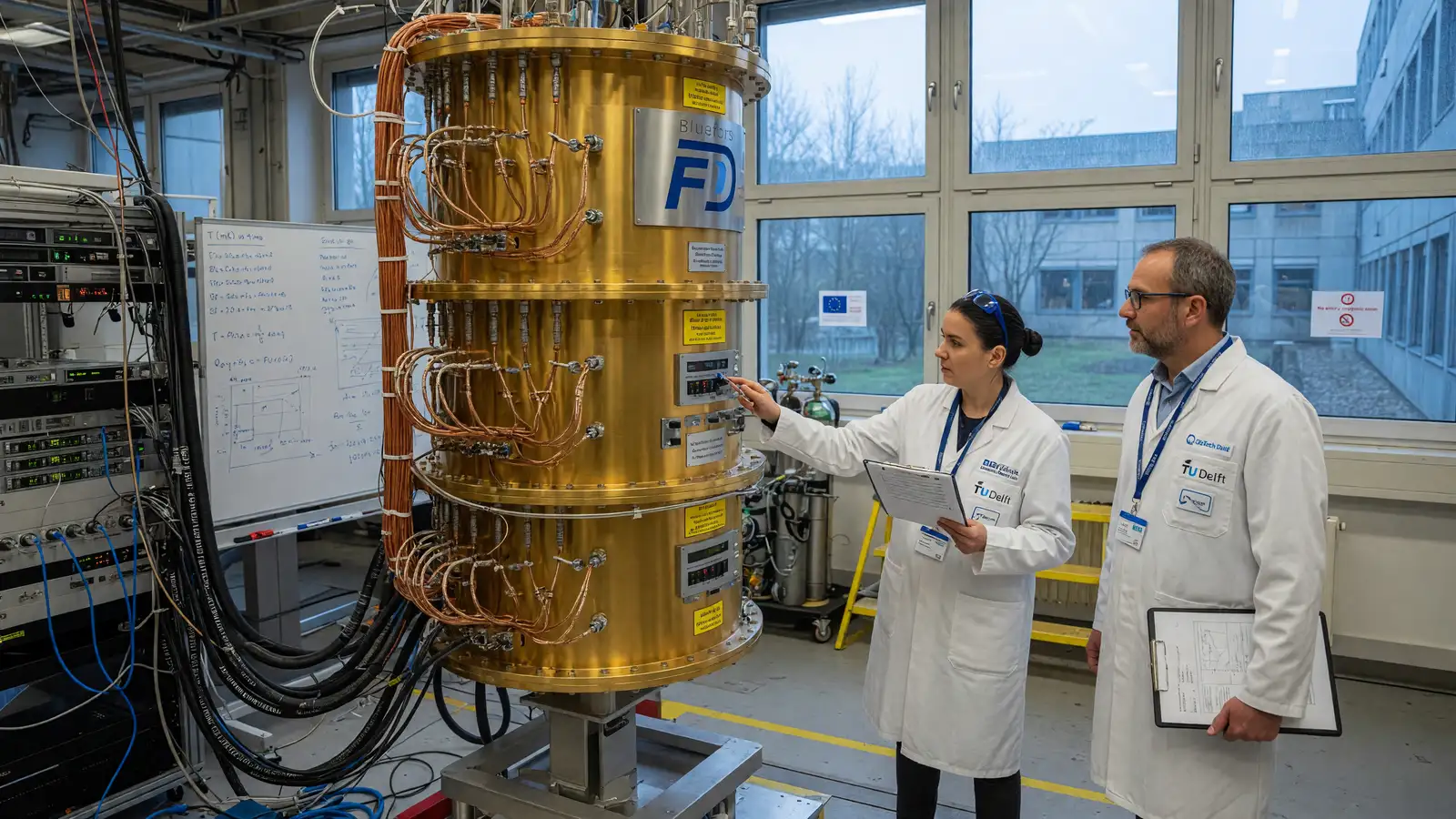
The problem the HKU chip solves is practical and, until recently, largely ignored. Quantum processors need to be cooled to millikelvin temperatures — colder than deep space. But the classical electronics that control them and read out their results sit at room temperature, connected by wires that conduct heat into the refrigeration system. Every additional qubit requires more control lines, more wires, and more heat. Scaling quantum computers beyond a few hundred qubits hits a thermal bottleneck: you can’t keep adding wires without overwhelming the cooling system.
Putting control electronics inside the refrigerator eliminates the wiring problem. The HKU chip uses neuromorphic architecture — circuits that mimic the behavior of biological neurons — to perform the kind of pattern recognition and signal processing needed to control qubits and interpret their outputs. The neuromorphic design is power-efficient by nature, generating minimal heat even at cryogenic temperatures. The chip also has applications in deep-space missions, where cryogenic temperatures are the ambient environment and power efficiency is critical.
The timing aligns with a broader push toward practical quantum computing infrastructure. The White House set a 2028 target for a discovery-class quantum computer that can perform tasks beyond the reach of classical simulation. Boeing completed a quantum networking lab test this week ahead of a planned 2027 space flight demonstration. The University of Tokyo achieved a breakthrough in fault-tolerant quantum protocols. The HKU chip fits the same pattern: the quantum computing race is shifting from “how many qubits can we build” to “how do we make the qubits we have actually useful.”
The cryogenic control problem has been a known bottleneck for years. Companies like Microsoft, IBM, and Google have all invested in cryogenic CMOS research, and several startups are focused specifically on control electronics for quantum systems. HKU’s approach is differentiated by the neuromorphic architecture, which is less general-purpose than standard CMOS but more efficient for the specific tasks quantum control requires.
The commercial implications are downstream but significant. If cryogenic control chips become standard components in quantum computers, the cost per qubit drops and the scalability ceiling rises. That matters because the gap between laboratory quantum computers and commercially useful ones is still measured in orders of magnitude — more qubits, lower error rates, better control. The HKU chip doesn’t add qubits. It makes the qubits we have easier to manage. That’s less exciting than a 1000-qubit announcement, but it might matter more for actually building something that works.