White House Quantum Push: US Sets 2028 Discovery Computer Target and 2030 Crypto Deadline
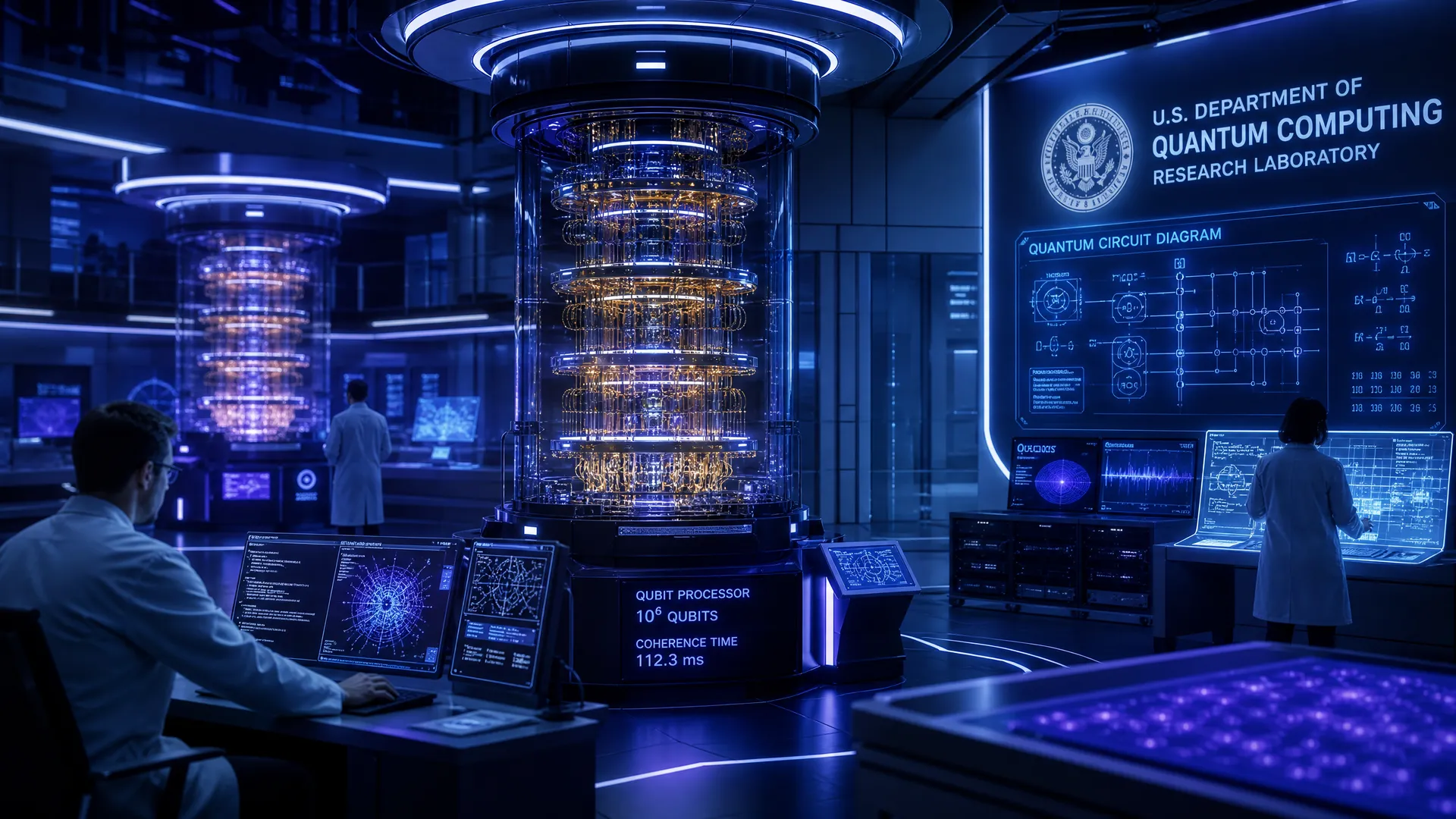
On June 22, 2026, the White House took one of its most consequential steps toward quantum readiness, when President Trump signed two executive orders that together create a coordinated national strategy for both building practical quantum computers and defending federal systems against quantum-era threats.
The move signals that quantum technology is no longer a distant research goal discussed in academic papers and corporate labs — it is now a declared national priority with concrete deadlines, federal funding mechanisms, inter-agency mandates, and a supply-chain strategy to back it all up.
The Two Orders
Order 1: “Ushering In The Next Frontier Of Quantum Innovation”
The first executive order launches what the administration calls the “Quantum Computer for Application Development and Discovery Science” program, to be housed at a Department of Energy facility. Its headline ambition is bold: build a powerful, useful quantum computer capable of driving genuine scientific discovery by 2028.
That two-year window is aggressive. Current quantum systems from leaders like IBM, Google, and IonQ operate at the scale of dozens to low hundreds of qubits, and while error correction is improving, no machine has yet demonstrated a clear practical advantage over classical supercomputers for real-world scientific problems. The order essentially sets a Manhattan Project-style timeline for quantum capability.
Beyond the hardware goal, the order establishes a broader framework that touches multiple dimensions of the quantum ecosystem:
-
Supply-chain coordination — securing domestic sources for the specialized components quantum systems require, from dilution refrigerators and cryogenic equipment to high-purity semiconductor materials and superconducting wiring. This is a direct response to concerns about reliance on foreign supply chains for critical quantum hardware.
-
Workforce development — expanding training pipelines for quantum engineers, software developers, and research scientists across universities, national laboratories, and private-sector partnerships. The quantum workforce shortage is well-documented, and the order aims to accelerate pipeline development at every level.
-
Research protection — tasking the FBI and the broader intelligence community with safeguarding American quantum research from foreign threats. This reflects ongoing concerns about technology transfer, intellectual property theft, and the strategic importance of maintaining a quantum advantage.
-
Inter-agency coordination — directing the Departments of Defense and Energy to collaborate on building and hosting the discovery-scale machine, leveraging both agencies’ existing quantum research infrastructure and classified expertise.
Order 2: Post-Quantum Cryptography Mandate
The second order addresses the defensive side of the quantum equation. It mandates that federal agencies deploy quantum-resistant encryption across high-value assets, with a compliance deadline of 2030 for key-establishment protocols.
This timeline addresses the widely recognized “harvest now, decrypt later” threat — a strategy in which adversaries, including nation-state actors, collect and store encrypted data today with the expectation that future quantum computers will be able to break current public-key cryptographic standards like RSA and elliptic-curve cryptography. Once a sufficiently powerful quantum computer exists, years of intercepted communications could be decrypted retroactively.
The White House has drastically shortened previous timelines for this migration, pushing agencies to accelerate their assessment and transition away from quantum-vulnerable algorithms. The National Institute of Standards and Technology (NIST) has already published post-quantum cryptography standards, and the order now makes their adoption mandatory rather than advisory for federal systems.
Industry Context
The federal push arrives alongside several notable industry developments that together paint a picture of a quantum ecosystem in rapid transition:
Amazon’s timeline. Peter DeSantis, Amazon’s AI executive, recently forecast that the first commercially useful small-scale quantum computers could arrive within five to seven years — placing operational machines on the market by the early 2030s. This aligns roughly with the federal 2028 research target, suggesting that the White House timeline, while ambitious, is grounded in industry consensus rather than wishful thinking.
IonQ’s role. Quantum computing company IonQ was specifically referenced in connection with the orders, with a 2028 federal security deadline that maps directly to the discovery computer goal. As one of the few publicly traded pure-play quantum companies, IonQ’s involvement signals that the administration expects private-sector partnership in achieving these objectives.
Academic progress. In a separate but highly relevant development, researchers successfully demonstrated a complete end-to-end workflow for executing classically bootstrapped variational quantum algorithms on a high-fidelity trapped-ion quantum computer, published in Nature. This achievement shows that hybrid quantum-classical methods — where classical computers handle parts of the computation while quantum processors tackle specific sub-problems — are maturing beyond theoretical proposals into practical tools for chemistry and materials science applications.
International landscape. The European Union’s quantum roadmap designates the end of 2026 as the first phase for deploying post-quantum tools, with later milestones in 2030 and 2035 — closely mirroring the US approach of phased deployment with a 2030 compliance horizon. China, meanwhile, continues to invest heavily in quantum communication networks and has already deployed quantum-secured links between major cities. The quantum race is genuinely global, and these executive orders are the US’s latest move to maintain competitive positioning.
What This Means for Organizations
The twin orders represent a significant shift in how the US government approaches quantum technology. Rather than treating it as a long-term research area worthy of grants and conference papers, the administration has set concrete, public deadlines: a functional discovery machine by 2028 and quantum-resistant cryptography across federal systems by 2030.
For organizations outside government, the implications are substantial:
-
Cryptographic inventory assessment. Companies that handle sensitive data, particularly in finance, healthcare, defense contracting, and critical infrastructure, should begin cataloging where quantum-vulnerable algorithms are used throughout their systems.
-
Migration planning. The transition to post-quantum cryptography is not a simple software update — it requires careful testing, compatibility assessment, and in some cases, hardware changes. Starting now is the prudent approach.
-
Talent and training. The workforce development provisions in the order will create new opportunities for quantum education, but organizations should not wait for government programs to build internal quantum literacy.
-
Investment and procurement. The orders create a potential boom in quantum-related procurement, supply-chain investment, and research funding over the next two to four years — an opportunity that both established quantum companies and new entrants will likely pursue aggressively.
Bottom Line
Quantum computing has moved from the laboratory to the Oval Office, and with 2028 and 2030 deadlines now codified in executive orders, the pace of change is set to accelerate dramatically. The race is no longer just about who builds the first practically useful quantum computer — it is about who prepares their infrastructure, their workforce, and their security posture for the quantum era first.
For technology leaders, the message from Washington is unambiguous: the quantum transition is happening, and the clock has started.