AI's Convergence Moment: Three Trends Colliding in July 2026 That Rewrite the Rules
Something shifted in the first half of July 2026. Not a single announcement or product launch — a convergence of several forces that, taken together, change what the AI industry looks like from here forward.
Anthropic’s Fable and Mythos models, restricted for nearly three weeks in June over national security concerns, are now back in circulation and setting a new performance ceiling that competitors are scrambling to match. OpenAI answered with Sol, a model early testers describe as a quantum leap in agentic capability. Elon Musk’s SpaceXAI released Grok 4.5 as part of a broader push that included a $60 billion acquisition of Cursor. And quietly, without much American fanfare, a Chinese startup called Z.ai put out an open-source model — GLM-5.2 — that performs in the same tier as the most expensive American frontier models (Axios, July 9).
Three separate stories. One converging signal: the AI industry is not consolidating around a single winner. It is fracturing into competing philosophies, each betting that a fundamentally different approach will win.
The Frontier Arms Race Just Hit a New Gear
The headline numbers are staggering. Anthropic’s Fable can handle entire multimillion-line codebases. Engineers hand it a repository and walk away for days while autonomous agents rebuild legacy systems, fix their own bugs, and test their own work with what Axios describes as “shockingly little oversight” (Axios, July 9). This is not autocomplete. This is not even a coding assistant in the traditional sense. This is a model functioning as an engineering team — reading documentation, making architectural decisions, writing tests, and deploying fixes without being asked to do each step individually.
OpenAI’s Sol takes a different approach to the same goal. Instead of one giant model doing everything, Sol summons swarms of sub-agents that collaborate, hunt for security flaws, and rewrite software in parallel. Developers who tested it reported speeds that made previous models “feel like dial-up.” Where Fable is a solo genius, Sol is an orchestra conductor — and the results are comparable enough that neither approach has a clear edge yet.
Then there is Grok 4.5, which is triple the size of its predecessor, with Musk promising another model “nearly twice as large” within a month. SpaceXAI is betting that raw scale — more parameters, more compute, more data — still wins. The company’s $60 billion Cursor acquisition suggests it plans to embed these massive models directly into developer tools, skipping the API-access model that Anthropic and OpenAI depend on and going straight to the end user. It is a vertical integration play in an industry still organized around horizontal layers.
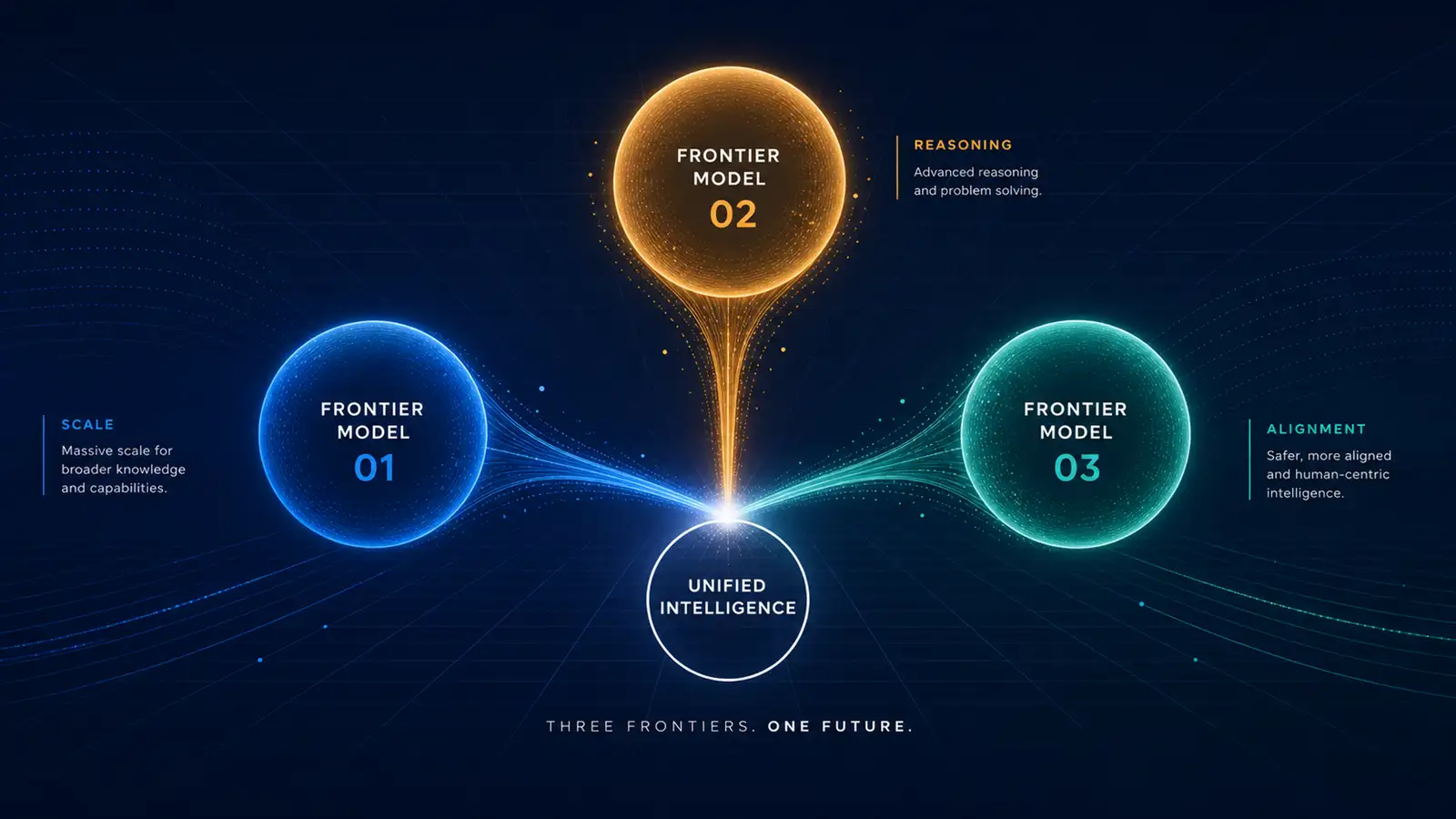
Three frontier labs. Three different bets on what matters most: agentic reasoning (Anthropic), multi-agent orchestration (OpenAI), or brute-force scale (SpaceXAI). At least one of those bets will look wrong a year from now. Nobody knows which one.
China Is Closing the Gap Faster Than the San Francisco Bubble Realizes
While the American labs compete on benchmarks that move every month, China is competing on something harder to measure but arguably more consequential: accessibility.
Z.ai’s GLM-5.2 is free to download, fully open-source, and performs at a level that matches America’s priciest proprietary models. Founder Jie Tang told Axios that China will produce a “Fable-class” model before the first quarter of 2027 (Axios, July 9). That timeline — roughly six to eight months — is aggressive, but the trajectory supports it. Eighteen months ago, Chinese models were a generation behind. Now they are roughly neck and neck on several key benchmarks, and the gap continues to shrink.
The implications go beyond who wins the leaderboard. Open-source frontier models mean any company, in any country, can download state-of-the-art AI and run it on their own infrastructure. No API keys, no usage limits, no dependency on a San Francisco company’s pricing decisions. For enterprises in regulated industries — finance, healthcare, defense — that shift from “renting intelligence from a vendor” to “owning intelligence on-premises” changes procurement decisions at scale.
The American labs are aware of this. Anthropic restricted Fable and Mythos for three weeks in June specifically because of security concerns about model access. The tension between “move fast and deploy” and “move carefully and control” will only intensify as open-source alternatives close the performance gap.
It is worth pausing on what “free to download” actually means in practical terms. A mid-size bank in Brazil, a telecom company in Indonesia, a government agency in Nigeria — none of these will pay Anthropic or OpenAI $200,000 a month for enterprise API access. But they can download GLM-5.2, run it on their own servers, and build AI-native products for their local markets without ever touching a U.S. vendor. The economic impact of that shift — from centralized AI rent to distributed AI ownership — may turn out to be bigger than any benchmark leaderboard.
From Single Agents to Swarms: The Architecture Shift Nobody Noticed Until Sol
For two years, the industry narrative was linear: models get bigger, benchmarks go up, and eventually you reach AGI. Sol broke that narrative by demonstrating that how you orchestrate models matters at least as much as how big they are.
The concept is not new — multi-agent systems have been a research topic for years. But Sol made it product. The swarms of sub-agents it deploys are not a theoretical construct; they are a practical architecture that produces measurably better results than a single large model working alone. An agent for code review, an agent for security analysis, an agent for documentation, all running in parallel and coordinating through a central orchestrator.
This shifts the bottleneck from model quality to system design. Give Sol a complex task — refactor a legacy payment processing pipeline, say — and it does not just generate code. It spins up one agent to map the existing architecture, another to identify performance bottlenecks, a third to write the new implementation, a fourth to review the output for security vulnerabilities, and a fifth to generate test cases. They work simultaneously, passing results back to the orchestrator, which synthesizes the output into a coherent pull request. A single large model doing all of this sequentially would take longer and produce worse results, because context windows get diluted across too many subtasks.
This has a counterintuitive implication: the next breakthrough in AI capability might not come from a better model. It might come from a better way of making existing models talk to each other. If Fable-level intelligence can be approximated by orchestrating three Sol-level sub-agents, then the economic advantage shifts from the company with the best model to the company with the best orchestration layer. The moat moves up the stack.
Forbes captured the bigger picture in a piece published the same week. Chuck Brooks described the emergence of “cognitive AI ecosystems” — intelligence fabrics where AI, quantum computing, neuromorphic architectures, robotics, and brain-computer interfaces converge into systems that are greater than the sum of their parts (Forbes, July 9). The autonomous agents we are building today are not the end state. They are components in a larger architecture that is still taking shape.
What Cognitive AI Ecosystems Actually Mean
The term “cognitive AI ecosystem” is easy to dismiss as consultant-speak, but the underlying idea is concrete. A single AI model, however powerful, operates in isolation. It takes an input, produces an output, and stops. A cognitive ecosystem connects multiple models to sensors, databases, robots, and each other in a continuous feedback loop.
The hospital of the future runs an AI ecosystem that monitors patient vitals through wearable sensors, cross-references symptoms against medical literature in real time, adjusts treatment plans based on outcomes, and deploys robotic assistants for routine care — all without a human coordinating the handoffs between systems. The factory of the future does the same for supply chains, quality control, and predictive maintenance. Brooks points to firefighting, underwater repair, radioactive remediation, and interplanetary construction as domains where embodied AI will take over tasks that are simply too dangerous for humans. These are not science fiction scenarios. They are the logical endpoint of the Sol architecture scaled across entire industries.
Brooks’ piece flags the ethical conversation that needs to happen in parallel: if AI systems gain persistent memory, long-term planning capability, and control over physical infrastructure, the question of who sets their objectives stops being academic (Forbes, July 9). The three-week Fable restriction in June was a preview of how governments will react when these systems cross thresholds that trigger national security reviews.
The Real Question Is Who Controls the Stack
The week of July 7 to 11, 2026, clarified something that was fuzzy before: there will not be one AI that wins. There will be multiple AI architectures competing on multiple dimensions — capability, cost, accessibility, control — and the winners on each dimension may be different companies in different markets.
Anthropic leads on autonomous reasoning. OpenAI leads on orchestration. SpaceXAI is betting on scale and distribution. China is winning on open-source accessibility. The cognitive ecosystem vision suggests that none of these advantages are permanent, because the next phase of competition is not about models at all — it is about how you connect them.
For the rest of us watching from the outside, the practical takeaway is simpler than the strategic analysis: the gap between what AI can do and what most organizations are using it for has never been wider. The frontier is moving faster than adoption, and that gap is growing. July 2026 is the month that became impossible to ignore.
One data point makes the scale of this gap concrete. Anthropic’s Fable can autonomously manage a multimillion-line codebase for days without human intervention. Most Fortune 500 companies are still figuring out how to use last year’s models for internal document search. The organizations that close this gap fastest — not the ones with the biggest AI budget, but the ones that redesign their workflows around what these systems actually do — will pull ahead in ways that compound. The technology is no longer the constraint. Organizational imagination is.
Sources:
- Axios: 3 big AI trends colliding at the same time (July 9, 2026)
- Forbes: Beyond Agentic AI — The Emergence of Cognitive AI Ecosystems (July 9, 2026)
Related Articles

98% of Enterprise Leaders Would Trust AI Agents in Production — If the Guardrails Exist