Quantum Computing's Real-World Breakthroughs: From Cancer Detection to Fusion Energy
Quantum computing has spent most of its existence in the realm of theoretical potential. The technology has been “five years away” from practical applications for about two decades. But something shifted in 2026. Quantum computers are now solving real problems in healthcare and energy research, and the results are starting to look less like laboratory curiosities and more like the foundation of something genuinely useful.
The shift isn’t about raw quantum supremacy, that overused metric of doing something faster than classical computers. It’s about hybrid approaches that combine quantum and classical computing to solve problems that neither could handle alone. And the problems being solved are the kind that matter: detecting cancer earlier and making fusion energy a reality.
Finding cancer with quantum-enhanced AI
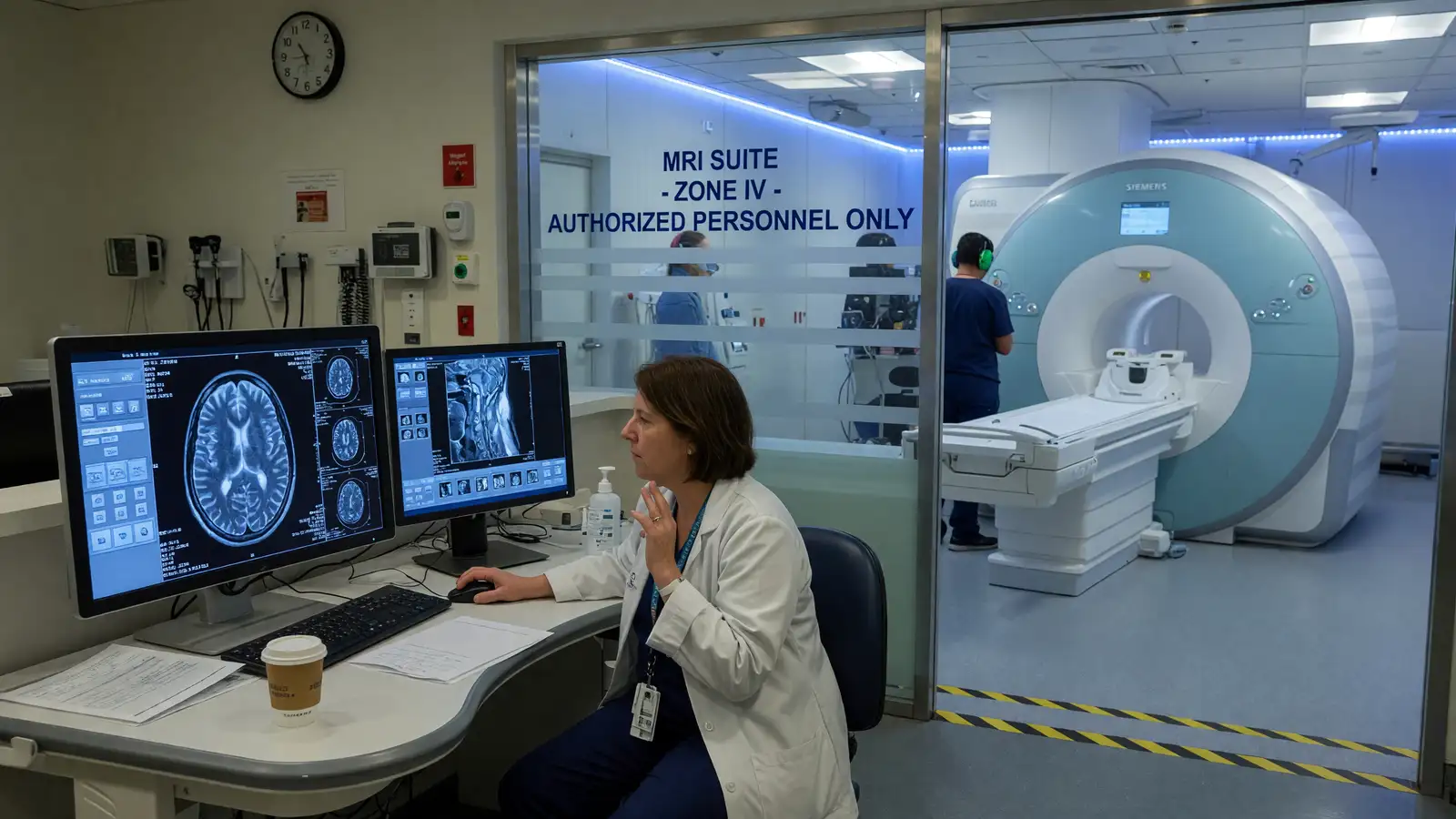
At USC Viterbi’s Information Sciences Institute, lead quantum scientist Amir Kalev is working on a problem that sounds simple but isn’t: teaching computers to see the exact boundaries of a tumor in a medical image. The technical term is image segmentation, and it’s the difference between a radiologist saying “there’s something there” and saying “here’s exactly where it starts and ends.”
“Medical imaging is an area where precise predictions are essential,” Kalev says. And he’s right. When a doctor is planning surgery or calibrating radiation therapy, knowing the precise outline of a tumor matters enormously. Too aggressive and you damage healthy tissue. Too conservative and you leave cancer cells behind.
Kalev’s approach combines quantum computing with artificial intelligence. The AI handles the pattern recognition that medical imaging requires. The quantum component adds computational capabilities that classical systems struggle with, particularly when dealing with the complex probability calculations that underlie accurate image segmentation.
The work is still in early stages, but the potential is significant. Current AI tools for medical imaging are good, but they have blind spots. They can miss subtle boundaries between cancerous and healthy tissue, especially in complex anatomical areas. Quantum-enhanced approaches could fill those gaps, giving doctors clearer pictures and more precise targets.
This matters because cancer treatment is increasingly personalized. Two patients with the same type of cancer in the same location might need very different treatment plans based on the exact shape and extent of their tumors. Better imaging leads to better treatment decisions, which leads to better outcomes. It’s a chain that starts with computational accuracy and ends with human lives.
The quantum advantage in this context isn’t about speed, though that helps. It’s about the ability to model quantum mechanical interactions in tissue at a level of detail that classical computers approximate but don’t fully capture. When a quantum computer analyzes a medical image, it can consider the probabilistic nature of tissue boundaries in ways that classical algorithms handle only through simplifying assumptions. Those assumptions work well enough most of the time, but in the cases where they fail, the consequences can be significant.
Kalev’s team is particularly focused on brain tumors, where the boundary between cancerous and healthy tissue is especially difficult to map. The brain’s complex architecture means that tumors often interweave with critical structures, making precise segmentation essential for surgical planning. A quantum-enhanced AI that can map these boundaries more accurately could mean the difference between preserving cognitive function and losing it.
Solving fusion’s materials problem
Meanwhile, at Oak Ridge National Laboratory, a different quantum computing application is tackling one of the fundamental challenges facing fusion energy: understanding how materials behave under the extreme conditions inside a fusion reactor.
Thiago J. Pinheiro, a recent Rice University PhD graduate, is part of a collaboration between ORNL, Cleveland Clinic, and IBM that performed the first known quantum computing calculations on molecular structures in a molten salt relevant to fusion energy. The salt, called FLiBe (a mixture of lithium fluoride and beryllium fluoride), is a leading candidate for the liquid “blanket” that would surround a fusion reaction in future reactors.
Here’s why this matters: fusion reactors need a blanket material that can absorb the neutrons released by the fusion reaction and convert them into tritium, a rare hydrogen isotope needed as fuel. Understanding how tritium interacts with FLiBe at the molecular level is essential for designing systems that can produce and recover enough tritium to sustain a fusion reactor.
The problem is that these molecular interactions are incredibly complex. Classical computers can approximate them, but the approximations introduce errors that compound over time. Quantum computers, by their nature, can represent these quantum mechanical interactions more accurately. The challenge has been getting quantum computers to do this reliably enough to be useful.
The ORNL-Cleveland Clinic-IBM collaboration used what they call “quantum-centric supercomputing” — dividing complex calculations between classical and quantum computers. The classical systems handled the straightforward computational work. The quantum systems tackled the molecular quantum mechanics that classical computers can’t handle efficiently. The combination produced results that neither approach could achieve alone.
This is a practical demonstration of something the quantum computing field has been promising for years: quantum advantage in real-world applications. Not quantum advantage in a carefully constructed benchmark, but quantum advantage in solving a problem that matters for humanity’s energy future.
The commercial reality
The technical achievements are impressive, but they’re happening alongside a commercial reality that’s more complicated. Quantum Computing Inc. (QCi), a publicly traded quantum and photonics company, just reported its Q2 2026 financial results, and they tell a story of rapid growth mixed with ongoing losses.
QCi’s revenue jumped to $5.55 million, a 50% increase from the previous quarter and a 90-fold increase from a year ago. The company has made three acquisitions this year, expanding into photonics and semiconductor manufacturing. It’s sitting on $1.3 billion in cash and investments.
But the company is also losing money. Operating expenses hit $21.85 million, resulting in an operating loss of $23 million. This is typical for quantum companies in 2026: they’re growing fast, investing heavily, and not yet profitable. The bet is that the technology will eventually justify the investment.
The commercial quantum computing market is in an awkward adolescence. The technology works well enough for specific applications, but not well enough for general-purpose computing. Companies like QCi are finding niches where quantum computing adds real value — photonics, sensing, specific optimization problems — while the broader dream of quantum supremacy over classical computing remains elusive.
What’s actually working
The pattern that’s emerging in 2026 is that quantum computing works best when it’s paired with classical computing, not when it’s trying to replace it. The USC cancer detection research uses quantum computing to enhance AI. The fusion energy research uses quantum computing to handle molecular simulations that classical computers struggle with. QCi’s commercial success comes from quantum-enhanced photonics, not from building a general-purpose quantum computer.
This hybrid approach makes sense. Classical computers are incredibly good at most things. They’re fast, reliable, and well-understood. Quantum computers excel at specific types of problems — molecular simulation, optimization under uncertainty, certain types of machine learning — where quantum mechanics provides a natural advantage. The practical path forward isn’t about quantum computers doing everything better. It’s about quantum computers doing specific things that classical computers can’t do well, and integrating those capabilities into broader systems.
The healthcare and energy applications demonstrate this clearly. You don’t need a quantum computer to run a hospital or manage a power grid. But you might need one to analyze medical images with unprecedented precision or to simulate the molecular behavior of materials in a fusion reactor. The quantum computer does what it’s good at. The classical computer does the rest. The combination is more powerful than either alone.
What comes next
The quantum computing field is at an inflection point. The technology has moved from “can it work?” to “where does it work best?” The answers are coming from practical applications, not theoretical benchmarks. Cancer detection and fusion energy research are leading the way, but they won’t be the last.
The commercial market will continue to grow, driven by specific applications rather than general-purpose computing. Companies that find the right niches where quantum computing adds clear value will thrive. Companies that bet on quantum supremacy as a general-purpose replacement for classical computing will struggle.
For the rest of us, the practical implications are straightforward: better medical diagnostics and cleaner energy, enabled by quantum computing working alongside classical systems. That’s not the sci-fi future that quantum computing was supposed to deliver. It’s something better: a useful future, built on technology that actually works.
The timeline for these applications is becoming clearer. Kalev’s medical imaging work is in early research stages, but the path from laboratory to clinical tool is well-established in medical technology. The fusion energy research is further along, with the ORNL collaboration demonstrating that quantum computing can handle the molecular simulations needed to design fusion reactor materials. The commercial market is already generating revenue, even if profits remain elusive.
What’s different about 2026 compared to previous years is that the applications are specific and measurable. You can point to a cancer detection algorithm that uses quantum computing and say whether it performs better than the classical alternative. You can point to a fusion materials simulation and say whether the quantum approach produces more accurate results. You can look at QCi’s revenue and say whether the company is growing.
This specificity matters because it moves the conversation away from hype and toward evaluation. The quantum computing industry has spent years promising everything to everyone. Now it’s delivering specific things to specific users, and the results are being measured against concrete criteria. That’s how technologies mature, and it’s a healthy development for a field that has sometimes been its own worst enemy in terms of expectations management.
The next few years will likely see quantum computing expand into additional practical domains: drug discovery, materials science, financial modeling, and logistics optimization. Each of these areas has specific problems where quantum mechanics provides a natural advantage. The pattern established in healthcare and energy research — hybrid quantum-classical approaches targeting specific, measurable improvements — will likely repeat in these new domains.
For now, the most important thing is that quantum computing is working. Not in theory, not in carefully constructed demonstrations, but in real applications that matter. Cancer patients and energy researchers are the early beneficiaries, but they won’t be the last. The technology has earned the right to be taken seriously, and the practical results justify the continued investment in making it better.