
CNN Says About $1,300. The Sticker Was $1,299.
CNN's Oct. 13 piece prices Meta's VR glasses at about $1,300 and 3.5 ounces. PPC Land on Oct. 15 still prints the $1,299 spring sticker.
The rounded price and the sticker are one dollar apart, and the pages do not treat that dollar the same way. CNN Business on October 13 says Meta’s coming VR glasses are priced at about $1,300. PPC Land on October 15 says that by late September, Meta was preparing $1,299 virtual reality glasses for a spring launch. About $1,300 can be a journalist’s rounding of $1,299. It can also be a different number that happens to sit eleven dollars away from a thousand. The pages do not show the arithmetic. A recap that prints one price has chosen a page.
This site already had the September sticker, in the $1,299 puck note. That note used PC Guide’s $1,299, 100 grams on the face, and a spring 2027 window. We already split a patent count from a different count, in the Sony 419 note. We already had a headset filing whose quarter was a target, not a ship date, in the Pico B3110 note. This week is what two October writeups do to that sticker: one rounds it, one repeats it, and a third cost figure on the October 15 page does not agree with itself.
About $1,300 is CNN’s phrase. $1,299 is still the other page.
CNN’s sentence is “priced at about $1,300.” “About” is the hedge. The piece does not print $1,299, and it does not print a currency conversion. Mezha’s same-day rewrite uses the same phrase: priced at about $1,300. I am treating Mezha as a retelling of CNN, not as a second person who weighed the invoice. Two pages with the same “about $1,300” are one source wearing two URLs.
PPC Land’s $1,299 is attached to late September, not to October 13. “Prepared $1,299 virtual reality glasses for launch in the spring” is how that page describes the September state. It does not say the price changed between late September and October 13. It also does not say CNN is rounding. The usable record is which sentence you are about to repeat. If you say the glasses cost $1,300, you are using CNN’s round number and dropping “about.” If you say $1,299, you are using the September figure PPC Land reprinted on October 15, which matches the sticker this site already logged from PC Guide. Neither October page prints a receipt.
The ship window has the same problem, with a missing year. CNN says the glasses are next year’s, and that it tried them at Meta’s New York offices the week before the October 13 story, ahead of a launch in the spring. Mezha says they are planned for next year. PPC Land says launch in the spring, attached to the late-September preparation. None of those three October sentences, in the text I used, print 2027. The September spec sheet this site already covered did: spring 2027. “Next year” from an October 13, 2026 story is 2027 if you do the calendar. “The spring” without a year is a season. I am not going to write spring 2027 into CNN’s sentence. I am going to say CNN did not print the year, and the earlier sticker did.
3.5 ounces is close to 100 grams. I converted it. CNN did not.
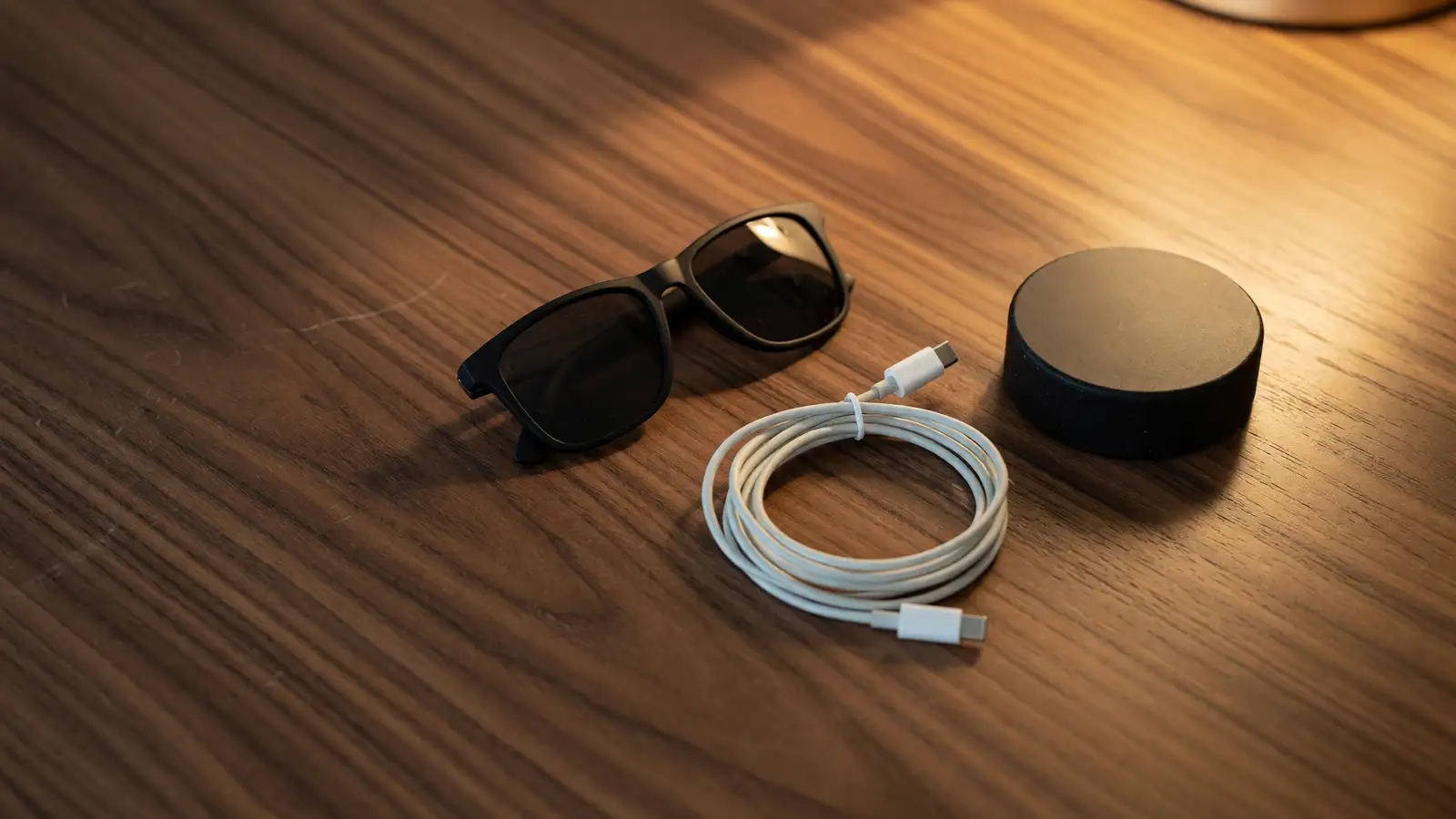
CNN says the new glasses resemble a giant pair of sunglasses and weigh about 3.5 ounces, because the computing components sit in a separate module on a wire. Mezha repeats about 3.5 ounces and the wire. The September note on this site had 100 grams for the glasses and about 300 grams for the puck, from PC Guide, and a 45W charging figure that only GSMArena printed. CNN’s October 13 extract does not print grams, and it does not print 300 grams or 45W. The puck’s gram weight is still a September figure. I am not moving it onto CNN.
I converted 3.5 ounces at 28.3495 grams per ounce. That is about 99.2 grams. CNN did not print 99.2, and it did not print 100. The September 100-gram line and the October 3.5-ounce line land near each other if you convert. That is not a conflict. A headline that says “CNN says 3.5 ounces, the spec sheet says 100 grams, so one of them is wrong” has refused to do the multiplication. They can both be “about” the same object. “About” is on CNN’s ounce line. 100 grams was PC Guide’s integer. A 0.8-gram gap after conversion is smaller than either page’s precision.
The Quest weight is the other conversion, and it is also not a clean fight. CNN says the Quest headsets Meta has been selling weigh about 18 ounces and look like a visor or a helmet. 18 ounces is about 510 grams, again my conversion, not CNN’s. The September line was that the glasses are “5x lighter than Meta Quest 3,” which is true of the part on your face if the glasses are 100 grams and the Quest is 500 grams. 510 and 500 are close. “About 18 ounces” can sit next to a 5x claim without one page disproving the other. I would not budget a neck from the 10-gram gap. I would also not write “Quest 3 is 18 ounces” into a spec sheet as if Meta printed it this week. CNN printed “about 18 ounces” for the headsets Meta has been selling. It did not name Quest 3 in that clause of the extract. The 5x sentence that names Quest 3 is still the September page.
Tuesday’s audio glasses are a different product
CNN says camera-free Ray-Ban Meta Audio glasses were launching Tuesday. October 13, 2026 was a Tuesday. Mezha’s extract, in the sections I used, talks about camera-free audio glasses as a category Amazon has sold since 2019, and quotes Alex Himel, Meta’s vice president of wearables, that the company decided two years ago to launch audio-only AI glasses in 2026. Mezha does not, in that extract, print “Tuesday.” The launch day is CNN’s. The 2026 decision is Mezha’s retelling of Himel. A sentence that says “Himel said they launch Tuesday” has merged the two.
CNN also says Meta still sells camera glasses, and last month introduced Ray-Ban Meta Gen 3, with a lighter design, a shortcut button, and longer battery life, according to the company. “Last month” from October 13 is September. “Lighter” has no gram figure in the extract. “Longer battery” has no hour figure. I am not going to fill those blanks from the VR glasses’ 3.5 ounces or from the September puck’s three-hour line. Gen 3 is a different object. The VR glasses are the wired, spring, about-$1,300 object. The audio glasses are the Tuesday launch. Gen 3 is the camera pair from last month. Three products. A chart with one row called “Meta glasses, October” has already lost.
The shipment figures in CNN are also not the VR glasses. Shipments of smart glasses are expected to grow 263% in the first half of 2026, and Ray-Ban parent EssilorLuxottica sold more than 7 million AI glasses last year. “Expected” is a forecast. “Last year” is 2025 if the story is October 2026. More than 7 million is a floor, not a point. 263% has no base printed in the extract I used. I am not going to turn 7 million into a 2026 VR-glasses install base. Those sentences are about AI glasses as a category, in CNN’s lede, next to a privacy caveat. They are not a count of the spring headset.
The cumulative bill has three numbers on one October 15 page
The price of the glasses is not the price of the division. PPC Land, in the same October 15 piece that reprints the $1,299, lines up three accounts of what Reality Labs has cost. MediaPost has cited more than $70 billion over six years. AdExchanger has cited $73 billion in five. A BBC presenter, quoted by PPC Land on October 4, 2026, said “$80 billion almost” before the project was dropped. Three figures, three windows, one page. More than $70 billion is a floor over six years. $73 billion is a point over five years. “$80 billion almost” is a spoken approximation, dated October 4 in PPC Land’s own earlier quote, and it is attached to a project being dropped, which is a different verb from a division that is still shipping glasses.
I am not averaging 70, 73, and 80. The average would be a number nobody published. I am also not picking the largest and calling it the loss. “More than $70 billion” can sit under $73 billion or under $80 billion without contradiction, because “more than” has no ceiling, and the year counts differ. Six years and five years are not the same span. A per-year figure would require a division the pages did not print. “$80 billion almost” can be a rounder talking over a $73 billion citation, or a different ledger. PPC Land puts them in one paragraph and does not reconcile them. That is the useful part. The paragraph is the warning against a single Reality Labs number.
The same page cites MediaPost’s Colin Kirkland, from February 2026, on Horizon Worlds being separated from the Quest and made mobile-first, with about 1,500 Reality Labs staff laid off and Meta’s own virtual reality game studio closed. Samantha Ryan, then described as vice president of content at Reality Labs, said 86% of the time people spend in its headsets goes to third-party apps. Those sentences are February reporting as retold on October 15. I did not reopen the February MediaPost piece. “About 1,500” is PPC Land’s “about,” via MediaPost. 86% is a share of time in headsets, not a share of revenue, and not a share of the $1,299. A sentence that says “Meta cut 1,500 people and 86% of the metaverse” has changed a headcount and a time-share into one cut.
Horizon Worlds “failed to onboard players” is MediaPost’s description, as PPC Land quotes it, of the history as of late September. It is not a CNN sentence. CNN’s October 13 piece says Meta’s previous efforts and its big bet on the metaverse have largely flopped, then argues the company thinks AI agents, design, and displays will change the outcome. “Largely flopped” is CNN’s summary. It is not the $70 billion, and it is not the 86%. Daniel Newman of Futurum, in CNN, says the glasses are still a bit of a solution chasing a problem. That is one analyst’s line. It is not a shipment figure.
What still belongs on the September card
The September card this site already published is still the one with the year and the puck. $1,299. 100 grams on the face. About 300 grams in the puck. Spring 2027. A cable. Battery life phrased as “3+ hours” on one September page and “up to three hours” on another. CNN’s October 13 piece does not replace that card. It rounds the price to about $1,300, weighs the glasses at about 3.5 ounces, weighs the older headsets at about 18 ounces, and says spring without printing 2027. Mezha repeats CNN. PPC Land on October 15 still says $1,299 and spring, and then puts three incompatible Reality Labs totals in one paragraph: more than $70 billion over six years, $73 billion over five, and almost $80 billion in a BBC line PPC Land had already quoted on October 4.
The new nouns this week, which the September card did not carry, are the Tuesday audio-glasses launch, the Gen 3 camera pair with no gram weight in the extract, the 263% first-half forecast, and the more-than-7-million AI glasses figure for last year. Those are category numbers and a different product’s launch day. They do not revise the sticker.
If you are writing the price down, write the page next to it. CNN, October 13: about $1,300. PPC Land, October 15, describing late September: $1,299. If you are writing the weight, write the unit the page used, and convert beside it if you must. About 3.5 ounces is CNN. About 99 grams is a conversion. 100 grams is September. If you are writing what the division cost, you need three lines, not one, and you need to say that all three were already in dispute on a single October 15 page.