IonQ and Sandia Partner to Build Quantum Computers for National Security
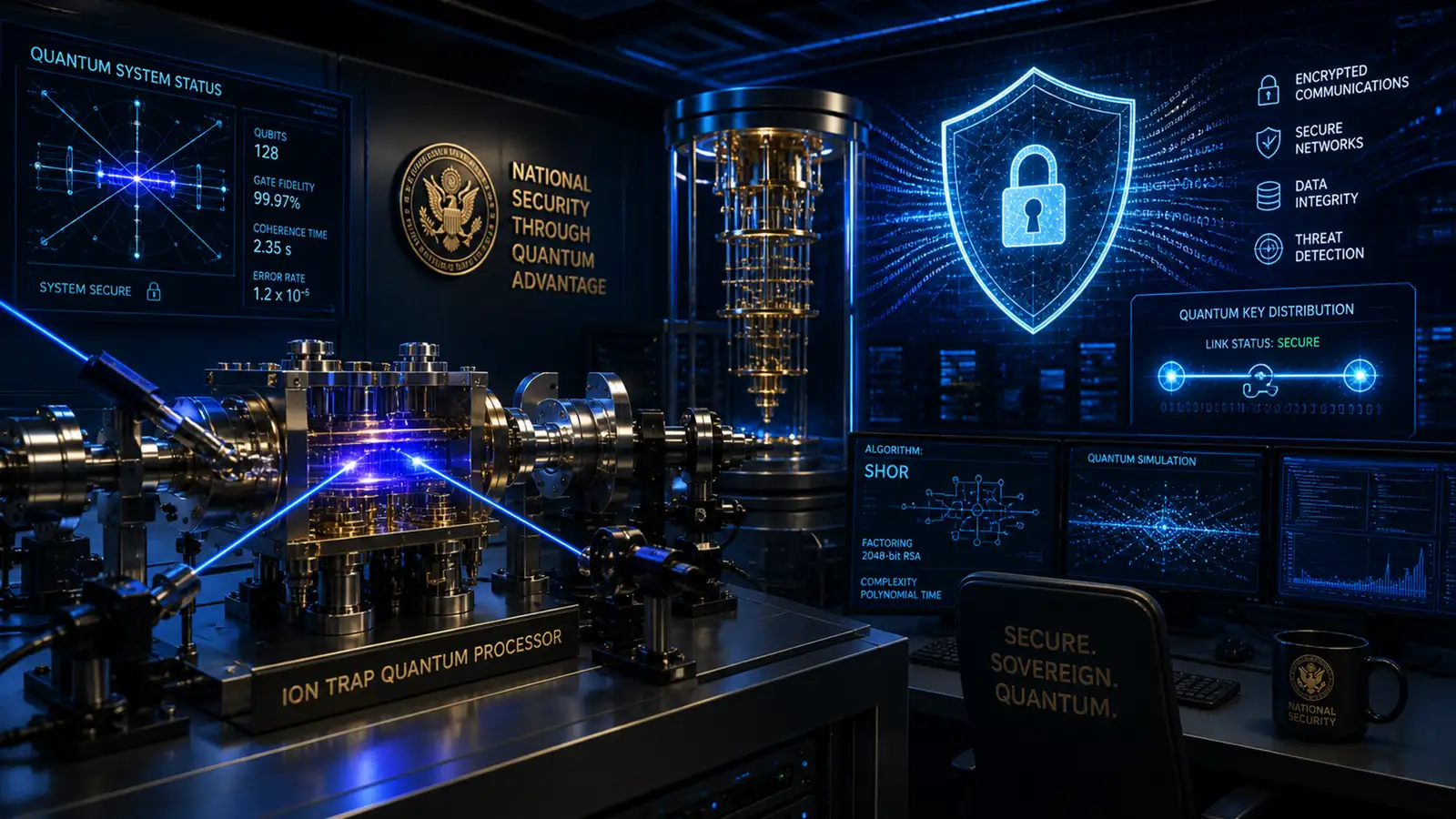
IonQ and Sandia National Laboratories have signed a Memorandum of Understanding to jointly develop quantum technologies for U.S. national security applications. The partnership, announced on August 5, represents one of the most significant collaborations between a quantum computing company and a national laboratory in recent years.
The agreement focuses on co-design of quantum information science technologies, meaning both parties will work together from the earliest stages of development rather than simply purchasing or licensing finished products. This approach is designed to accelerate the development of quantum systems that meet specific national security requirements.
Why national security matters for quantum
Quantum computing has long been recognized as a potential game-changer for national security. The ability to solve certain computational problems exponentially faster than classical computers could transform cryptography, materials science, and complex systems modeling. Both the U.S. and China have invested heavily in quantum research, viewing it as a strategic technology with implications for intelligence, defense, and economic competitiveness.
Sandia National Laboratories, one of the largest research and development institutions in the United States, has been working on quantum technologies for years. The lab’s focus on national security applications makes it a natural partner for IonQ, which has positioned itself as a leader in trapped-ion quantum computing.
The partnership comes at a time when concerns about quantum threats to current encryption systems are growing. While large-scale quantum computers capable of breaking modern encryption are still years away, the timeline is shrinking, and governments are investing in both quantum-resistant cryptography and quantum computing capabilities.
National security agencies have been particularly concerned about “harvest now, decrypt later” attacks, where adversaries collect encrypted data today with the expectation of decrypting it once quantum computers become powerful enough. This threat has accelerated investment in both quantum-resistant encryption and quantum computing capabilities that could be used for defensive purposes.
What the partnership involves
The MOU outlines several key areas of collaboration. First, the parties will work on co-designing quantum hardware and software specifically optimized for national security applications. This means developing quantum systems that can solve problems relevant to intelligence analysis, cryptanalysis, and complex system simulation.
Second, the partnership will focus on quantum algorithm development. National security applications often require specialized algorithms that differ from those used in commercial quantum computing. Sandia’s expertise in national security computing problems combined with IonQ’s quantum hardware could produce algorithms that neither organization could develop alone.
Third, the collaboration will address quantum networking and communication. Secure quantum communication is essential for national security, and both IonQ and Sandia have capabilities in this area that could be combined to advance the state of the art.
The co-design approach is particularly important because national security applications often have unique requirements that differ from commercial use cases. For example, intelligence analysis may require quantum systems that can process specific types of data, while cryptanalysis may require quantum computers optimized for particular mathematical operations. By working together from the start, IonQ and Sandia can ensure that the quantum systems they develop are specifically suited to these applications.
The trapped-ion advantage
IonQ’s trapped-ion quantum computing approach has several characteristics that make it particularly relevant for national security applications. Trapped-ion systems offer high gate fidelity, long coherence times, and the ability to operate at room temperature, which simplifies deployment in various environments.
The company’s quantum systems have demonstrated some of the highest quantum volume scores in the industry, indicating their ability to perform complex calculations. For national security applications that require solving difficult computational problems, this capability is essential.
IonQ has also been developing quantum networking capabilities that could enable secure quantum communication between distant locations. For intelligence and defense applications, the ability to transmit information using quantum-secure channels would be a significant advantage.
The trapped-ion approach also offers advantages in terms of system stability and reliability. National security applications require quantum systems that can operate reliably over extended periods, and trapped-ion systems have demonstrated better stability than some alternative approaches. This reliability is critical for applications where system failures could have serious consequences.
Sandia’s role
Sandia National Laboratories brings deep expertise in national security computing and quantum research to the partnership. The lab has been working on quantum technologies for years, with particular focus on applications relevant to the Department of Energy and Department of Defense.
The laboratory’s computational sciences expertise includes experience with large-scale simulation, advanced algorithms, and high-performance computing systems. These capabilities are directly relevant to developing quantum applications for national security.
Sandia’s role will also involve testing and validating quantum systems for security-critical applications. National security systems require rigorous verification and validation processes, and Sandia’s experience in this area will be essential for ensuring that quantum technologies meet the demanding requirements of security applications.
The laboratory also has extensive experience in cybersecurity and cryptography, which is directly relevant to developing quantum-resistant security systems. As quantum computers become more powerful, the ability to develop and validate new cryptographic systems that can withstand quantum attacks will become increasingly important.
Implications for the quantum industry
The IonQ-Sandia partnership has several implications for the broader quantum computing industry. First, it demonstrates that quantum computing is moving beyond pure research toward practical applications, particularly in areas where the technology’s unique capabilities can provide genuine advantages.
Second, the partnership highlights the growing importance of national security as a driver of quantum computing investment. While commercial applications like drug discovery and financial modeling continue to drive quantum research, national security applications are increasingly influencing where resources are directed.
Third, the co-design approach represents a shift in how quantum technologies are developed. Rather than building general-purpose quantum computers and then finding applications, the partnership aims to develop quantum systems specifically optimized for particular use cases. This approach could accelerate the development of practical quantum applications.
The partnership also signals that quantum computing companies are increasingly looking beyond commercial markets for revenue and validation. National security contracts can provide stable funding and access to specialized expertise that might not be available in commercial markets. For quantum companies like IonQ, which are still working toward profitability, national security partnerships could provide an important revenue stream.
What comes next
The MOU establishes a framework for collaboration, but the actual work of developing quantum technologies for national security will take years. Both IonQ and Sandia will need to invest significant resources in the partnership, and the results will likely be measured in incremental advances rather than breakthrough announcements.
For IonQ, the partnership provides access to Sandia’s deep expertise in national security computing and validation processes. For Sandia, the partnership provides access to IonQ’s advanced quantum hardware and development capabilities. Together, they aim to accelerate the development of quantum technologies that could provide genuine advantages for national security applications.
The partnership also positions both organizations as leaders in the emerging field of quantum computing for national security. As governments around the world invest in quantum technologies, the ability to develop systems that meet security requirements will become increasingly important. The IonQ-Sandia collaboration puts both organizations at the forefront of this developing area.
Looking ahead, the success of this partnership could influence how other quantum computing companies approach national security applications. If IonQ and Sandia demonstrate that co-design can accelerate the development of practical quantum technologies, other organizations may adopt similar approaches. This could lead to a new model for quantum computing development that combines commercial innovation with government expertise and requirements.
The geopolitical context
The IonQ-Sandia partnership must be understood in the context of growing geopolitical competition in quantum computing. China has made quantum technology a national priority, investing billions of dollars in quantum research and development. The Chinese government has identified quantum computing as one of several strategic technologies that could reshape the global balance of power.
In response, the United States has increased its investment in quantum research, with both government agencies and private companies working to maintain technological leadership. The IonQ-Sandia partnership represents a concrete example of this effort, combining private sector innovation with government expertise and requirements.
The national security implications of quantum computing extend beyond cryptography. Quantum computers could potentially simulate complex systems with unprecedented accuracy, providing advantages in materials science, drug discovery, and climate modeling. For national security agencies, these capabilities could transform intelligence analysis and strategic planning.
Challenges and limitations
Despite the promise of the partnership, significant challenges remain. Quantum computing technology is still in its early stages, and practical quantum computers capable of solving national security problems are years away. The partnership will need to navigate technical challenges related to qubit stability, error correction, and system scaling.
There are also practical challenges related to integrating quantum computing into existing national security infrastructure. Government agencies have invested heavily in classical computing systems, and integrating quantum capabilities will require significant changes to workflows, security protocols, and personnel training.
The partnership will also need to address intellectual property and security concerns. National security applications often involve classified information and sensitive technologies, and the partnership will need to establish appropriate safeguards to protect this information while enabling effective collaboration.
Looking forward
The IonQ-Sandia partnership represents an important step in the development of quantum computing for national security applications. While significant challenges remain, the combination of IonQ’s quantum hardware expertise and Sandia’s national security computing knowledge creates a powerful foundation for future development.
As quantum computing technology matures, partnerships like this one will become increasingly important. The ability to develop quantum systems specifically optimized for national security applications could provide significant advantages for the United States and its allies. The IonQ-Sandia collaboration puts both organizations at the forefront of this developing field, and its success could influence how quantum computing is developed and deployed for security applications in the years ahead.