The GENIUS Act Is Law. The Stablecoin Market Isn't Waiting for It to Work.
The GENIUS Act became law on July 18, 2025. Almost thirteen months later, its operative provisions still aren’t in force. The substantive stablecoin regime, the one that defines who can issue stablecoins in the United States, what reserves they need, and how they must disclose, remains on paper.
The delay matters because the stablecoin market hasn’t stopped growing while waiting. Tether’s USDT has over $180 billion in circulation. Circle’s USDC continues to expand. PayPal’s PYUSD is gaining traction. The market is building on top of a regulatory framework that doesn’t officially exist yet.
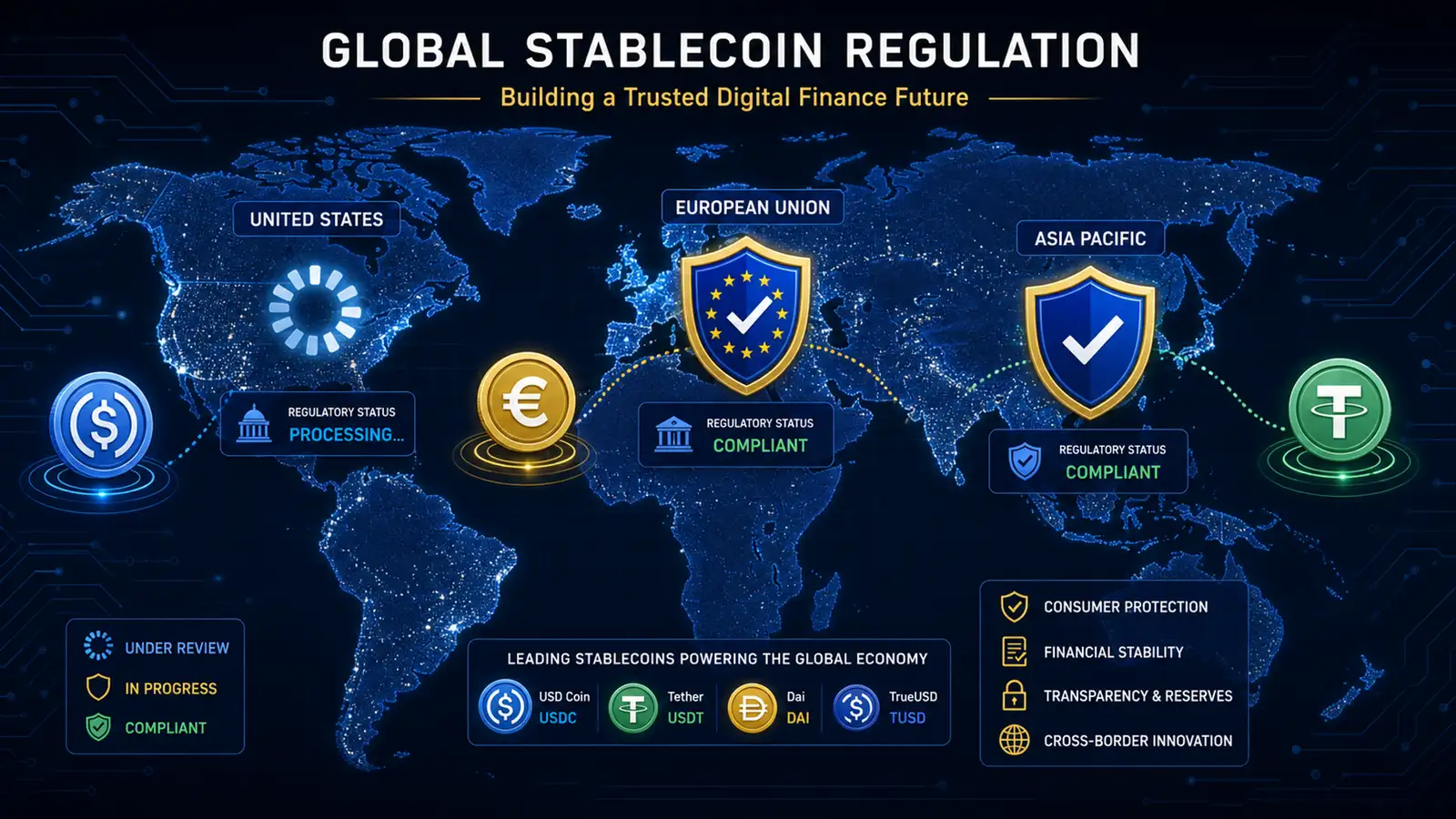
Meanwhile, the EU’s MiCA regulation is live. Hong Kong has an operative licensing regime with two licensed issuers. Japan’s framework is running. The global stablecoin regulatory map is being drawn, and the US is still arguing about where to put the pen.
What the GENIUS Act actually requires
The GENIUS Act restricts stablecoin issuance to three types of entities: federally chartered banks, OCC-supervised nonbank issuers, and state-qualified issuers operating under a state regime certified as substantially similar to the federal framework. Foreign issuers wanting to serve US customers must meet equivalent standards or operate through a licensed US subsidiary.
The reserve requirements are straightforward and strict. Every payment stablecoin in circulation must be backed one-to-one by high-quality, liquid, dollar-denominated reserves. Permissible assets include short-term Treasury instruments and bank deposits. Rehypothecation and lending of customer reserves are tightly restricted, and reserves must be segregated from the issuer’s own operating funds. The intent is to prevent the kind of reserve commingling that contributed to previous stablecoin failures.
Transparency requirements include monthly disclosures of reserve composition and total stablecoins outstanding, certified by senior officers of the issuer. Larger issuers need annual audited financial statements. The goal is to make reserve information verifiable rather than dependent on issuer assertions. Holders must be able to redeem each token for one dollar on demand, subject to commercially reasonable terms disclosed in advance. Issuers must maintain redemption processes that work in both normal and stressed market conditions.
The law also brings stablecoin issuers into the Bank Secrecy Act framework, applying sanctions and customer-identification rules that govern traditional financial institutions. Risk management standards cover capital, liquidity, operational risk, and cybersecurity. This is a significant compliance burden for crypto-native issuers that have never operated under banking regulations.
One provision that hasn’t gotten enough attention: when effective, the GENIUS Act prohibits permitted issuers from paying interest or yield solely for holding, using, or retaining a stablecoin. That’s a significant constraint on the DeFi composability that makes stablecoins useful beyond simple payments. It doesn’t prohibit every distributor reward, but it draws a clear line around what counts as interest for holding a stablecoin versus compensation for providing a service.
The enforcement gap
The GENIUS Act’s commencement mechanism uses the earlier of a statutory 18-month timetable and a 120-day period following the final implementing regulation. As of August 2026, no final federal implementation has triggered the earlier path yet. The OCC, FDIC, and NCUA have proposed implementation measures, but the Federal Reserve’s relevant rulemaking remains unfinished.
The FDIC’s April 2026 proposal is particularly telling. It’s evidence that implementation remains prospective, not imminent. The agencies are still working through the details of how to supervise stablecoin issuers under a framework that Congress already enacted. The gap between enactment and effectiveness is unusually long, and it’s creating uncertainty across the market.
This creates an awkward situation. The law exists. The market operates under it, at least in spirit. But the agencies haven’t finished writing the rules that make it enforceable. Issuers are in a gray zone where they’re expected to comply with a law whose enforcement machinery isn’t operational.
For large, well-capitalized issuers like Circle, this isn’t a crisis. They can afford to comply ahead of the rules, and they have. Circle has been pursuing GENIUS Act compliance from the start, positioning USDC as the regulated alternative. For smaller players and newcomers, the uncertainty is a significant barrier. You can’t build a business on a regulatory framework that might change before it takes effect, and you can’t raise capital from institutional investors who want regulatory clarity before they commit.
The SEC’s March 2026 interpretation adds another layer. The Commission concluded that the category of covered payment stablecoins it described is not a security. That’s helpful, but it’s narrower than declaring every instrument labeled “stablecoin” outside securities law. The boundary is being drawn, but it’s still blurry.
How the rest of the world is moving faster
The EU’s MiCA regulation has been operative for months. It covers not just stablecoins but exchanges, custodians, and other crypto service providers. The regulatory map shows MiCA effective in the EU, Hong Kong with an operative licensing regime and two licensed issuers, Japan’s framework running, and the UAE’s federal payment-token rules in force. These jurisdictions didn’t wait for perfect frameworks. They enacted what they had and started enforcing.
By contrast, the US GENIUS Act is enacted but not yet effective. The UK’s final FCA stablecoin rules don’t operate until October 25, 2027. Singapore’s 2023 SCS framework remains finalized policy rather than an operative statutory regime. The gap between “law exists” and “law works” varies wildly by jurisdiction.
The practical consequence is that stablecoin issuers can get licensed and operational in the EU and Asia faster than in the US. Circle has pursued MiCA compliance aggressively, positioning USDC as the EU’s stablecoin of choice. Tether launched USAT specifically to position for GENIUS Act compliance. The companies that move fastest in regulated markets will capture the most market share when enforcement finally arrives.
This fragmentation matters significantly for builders. If you’re building a payments product that uses stablecoins, you need to know which jurisdictions have clear rules and which don’t. The US, despite being the largest stablecoin market, is the least predictable from a regulatory standpoint.
Tether’s USDT problem
The GENIUS Act’s issuer restrictions are a direct challenge to Tether’s position in the US market. USDT, issued outside the United States, is not a permitted issuer under the GENIUS Act. That’s why Tether launched USAT as a separate, US-regulated stablecoin through Anchorage Digital Bank in January 2026.
The question is whether USAT can compete with USDT’s network effects. USDT has over $180 billion in circulation and is deeply embedded in global crypto trading, from centralized exchanges to DeFi protocols to cross-border payments in emerging markets. USAT is new, unproven, and operating under a framework that isn’t yet enforced.
Tether’s strategy seems to be hedging: keep USDT as the dominant global stablecoin while building USAT as the US-compliant alternative. If the GENIUS Act enforcement kicks in, USAT is ready. If it doesn’t, USDT remains the default. It’s a bet on regulatory ambiguity, and Tether has been good at navigating ambiguity.
For the broader market, Tether’s USDT problem illustrates a deeper tension. The GENIUS Act wants to bring stablecoin issuance into the regulated banking framework. But the market’s most popular stablecoin was built outside that framework, and its network effects are enormous. Regulation can change the rules, but it can’t easily change user behavior. Traders who use USDT for liquidity, merchants who accept it for payments, and protocols that build on it aren’t going to switch overnight because a law says they should.
The key distinction the GENIUS Act creates is between a claim on the issuer and a proprietary interest in the reserves. A $1 redemption promise doesn’t by itself make the holder owner of $1 of Treasury bills. Even full economic backing cannot answer who owns the assets when insolvency begins. The GENIUS Act creates statutory protections for holders, including treatment of required reserves outside the issuer’s bankruptcy estate, but that’s not the same as giving every holder a perfected security interest.
What this means for stablecoin users and builders
If you’re using stablecoins today, the regulatory landscape doesn’t change much immediately. USDT and USDC both work, both redeem at par, and both have reserves. The GENIUS Act’s enforcement timeline means nothing changes for end users in the near term.
But if you’re building on stablecoins, the picture is different. The GENIUS Act’s interest prohibition, when it takes effect, will constrain certain DeFi yield strategies. The reserve requirements will raise the bar for new issuers. The BSA/AML compliance requirements will add operational costs.
For DeFi protocols specifically, the interest prohibition is the most consequential provision. Many yield strategies rely on paying users interest for holding stablecoins in protocol-controlled pools. The GENIUS Act, when effective, would prohibit that for permitted issuers’ stablecoins. Protocols will need to find alternative incentive structures.
For builders choosing which stablecoin to integrate, the regulatory clarity question becomes important. USDC has been pursuing GENIUS Act compliance from the start. USDT’s status is ambiguous. Newer stablecoins like PYUSD are positioning for compliance. The choice of which stablecoin to build on now carries regulatory risk.
The convergence nobody talks about
Beneath the jurisdictional fragmentation, a quieter convergence is happening. The reserve requirements across the GENIUS Act, MiCA, Hong Kong, and the UK all point in the same direction: payment stablecoins are being pushed toward something resembling privately operated narrow balance sheets rather than leveraged banks.
Every major jurisdiction is converging on 1:1 backing in high-quality liquid assets. Every major jurisdiction is requiring transparency and disclosure. Every major jurisdiction is applying AML/KYC requirements. The details differ, but the principles are remarkably similar. A stablecoin issuer compliant in one jurisdiction has a significant head start on compliance in others.
This convergence matters because it creates a floor for the industry. The days of issuing stablecoins with opaque reserves and no regulatory oversight are ending. The new standard is clear: full backing, regular audits, redemption at par, and compliance with banking-style risk management. The market is already building in that direction. The regulation is catching up, just not as fast as anyone expected.
The GENIUS Act will eventually take effect. When it does, the US stablecoin market will look more like the EU’s: regulated, transparent, and constrained by reserve requirements that leave less room for the kind of leverage that made early stablecoins risky. The question isn’t whether this happens. It’s how much market share the US loses to jurisdictions that got there first.