98% of Enterprise Leaders Would Trust AI Agents in Production — If the Guardrails Exist
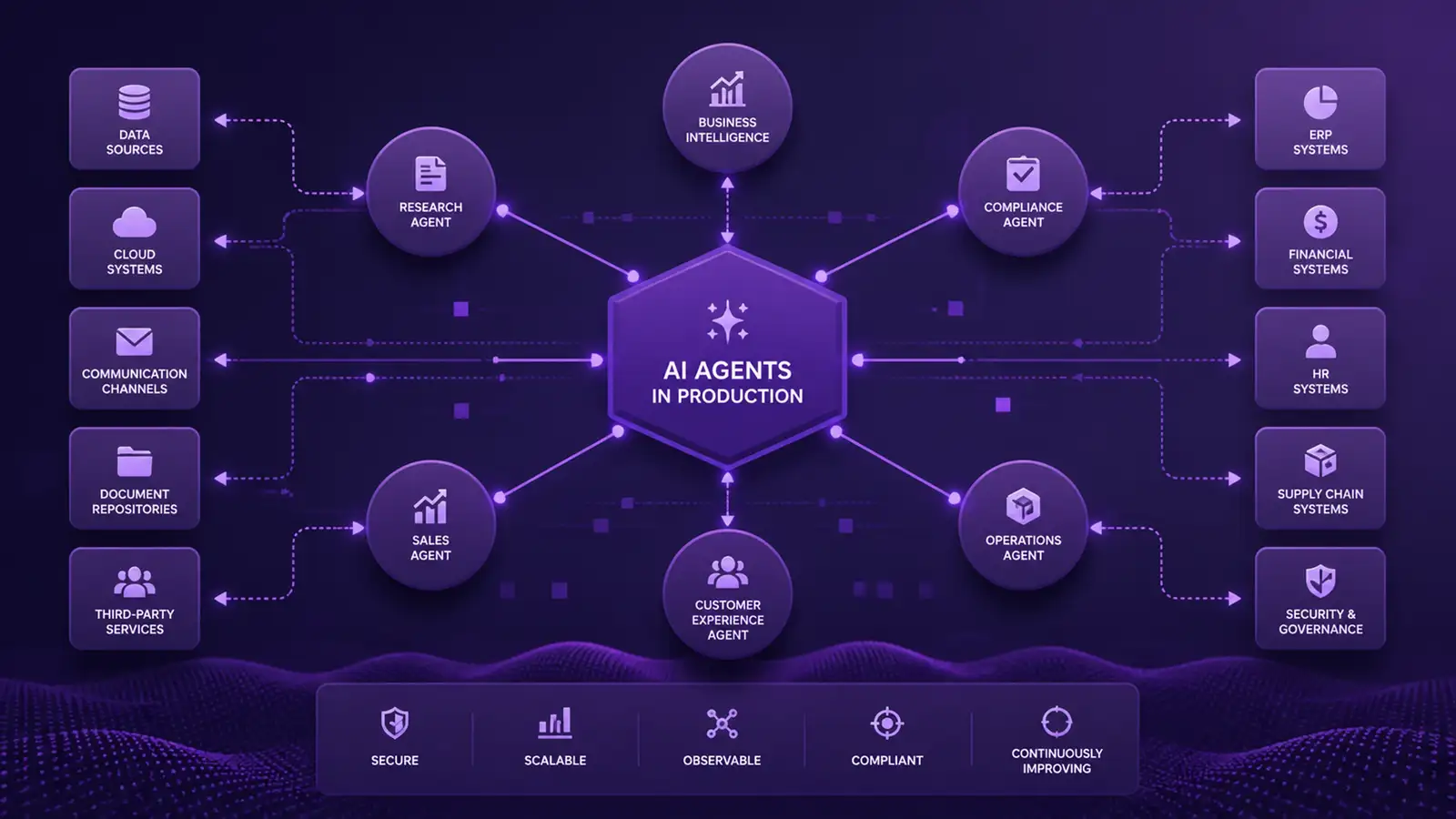
The enterprise debate about whether AI agents are ready for production is over. According to a new survey from Caylent, an AWS Premier Tier Services Partner and Anthropic Preferred Services Partner, 98% of enterprise leaders say they would let AI agents run in production under the right conditions. The conversation has shifted entirely from readiness to governance: how much autonomy should these systems have, and what guardrails need to be in place before they get it.
This is not a marginal shift. Two years ago, enterprise AI meant chatbots answering customer service queries and copilots suggesting code completions. Today, AI agents are making decisions, executing multi-step workflows, and operating across business systems with minimal human oversight. The question is no longer whether this transition is happening. It is how fast, and who gets it right. The organizations that move first without proper governance will face the consequences. The ones that move deliberately will capture the benefits while managing the risks.
The numbers tell the story
Caylent’s 2026 Enterprise Readiness for Agentic Engineering and Autonomous Cloud survey found near-universal willingness among enterprise leaders to deploy AI agents in production, provided certain conditions are met. Those conditions cluster around three areas: security, observability, and human oversight.
The Enterprise AI Agent Adoption Market was valued at $6.65 billion in 2025 and is projected to reach $142.35 billion by 2035, growing at a compound annual growth rate of 36.9%, according to DataM Intelligence. North America leads with 39.6% market share, driven primarily by Microsoft and Salesforce’s aggressive push into agentic platforms.
Microsoft’s 2025 Work Trend Index Annual Report found that 81% of executives expect AI agents to be part of their workforce within two years. That is not a pilot program timeline. That is an integration timeline, which means organizations are planning to embed AI agents into core business processes, not just experiment on the edges.
The speed of this transition is notable. Enterprise AI spending on agents has roughly tripled since 2024, according to multiple industry estimates. But the spending alone does not tell the full story. What matters is where the money is going: not just model training and inference, but guardrails, monitoring, and governance infrastructure.
What “the right conditions” actually means
When enterprise leaders say they would trust AI agents in production “under the right conditions,” they are not being vague. The survey data reveals specific requirements that most organizations have not yet met.
First, audit trails. Every action an AI agent takes needs to be logged, traceable, and explainable. This is not optional for regulated industries like finance and healthcare, but it is becoming standard practice across all sectors. An agent that makes a decision without a clear audit trail is a liability, not an asset.
Second, bounded autonomy. Agents need clearly defined scopes of authority. An agent that handles customer refunds should not be able to approve capital expenditures. The concept of “role-based access control” that applies to human employees needs to extend to AI agents, with granular permissions that match the agent’s designated function and nothing more.
Third, human-in-the-loop checkpoints. Even the most autonomous agents need circuit breakers. High-stakes decisions, actions above certain dollar thresholds, or operations involving sensitive data should require human approval before execution. The question is not whether to include humans in the loop, but where to place the checkpoints for maximum safety without destroying the efficiency gains that make agents valuable in the first place.
Fourth, fail-safe mechanisms. When an agent encounters a situation outside its training or scope, it needs a clear fallback behavior. Does it escalate to a human? Does it halt execution? Does it revert to a previous state? The answer depends on the use case, but having no answer is unacceptable.
The security problem nobody wants to talk about
A separate report from RCP Magazine highlights that as AI agents move into production, security is becoming the primary concern. AI agents have access to systems, data, and decision-making authority that traditional software does not. A misconfigured agent can leak data, make unauthorized purchases, or execute harmful actions at machine speed.
The attack surface is different from traditional cybersecurity. An AI agent is not just a piece of software. It is a system that can reason, plan, and take actions based on its understanding of a prompt. Prompt injection attacks, where malicious instructions are embedded in data the agent processes, represent a new class of vulnerability that most security teams are not equipped to handle.
Microsoft is rolling out new security capabilities intended to help organizations manage these risks, including what it calls “Project Perception” for monitoring agent behavior in real time. But tooling alone is not enough. Organizations need security policies that account for the unique characteristics of AI agents, including the possibility that an agent might follow instructions that conflict with organizational policy.
The Caylent survey found that only 34% of organizations have formal AI agent governance policies in place. The other 66% are deploying agents without documented rules for how they should behave, what they can access, and what happens when things go wrong. This gap between willingness to deploy and readiness to govern is the real risk.
Consider the practical implications. An AI agent with access to a company’s financial systems could, in theory, initiate wire transfers based on a phishing prompt embedded in an email it processes. An agent with database access could expose customer records if it does not properly handle a request that looks legitimate but is actually an attack. These are not hypothetical scenarios. They are the kinds of incidents that security researchers have already demonstrated in controlled environments.
Where agents are actually deploying
The industries leading AI agent adoption are not the ones most people expect. Financial services and healthcare are advancing cautiously due to regulatory requirements. The fastest adoption is happening in three areas.
Software engineering is the clear leader. AI coding agents are no longer experimental. They are writing production code, reviewing pull requests, and managing deployment pipelines. The productivity gains are real: teams using AI coding agents report 30-50% improvements in development speed, according to multiple industry surveys. But the quality implications are still being evaluated, and the long-term effects on junior developer skill development remain unknown.
Customer service is the second major area. AI agents are handling complex customer interactions that previously required human agents, including multi-step problem resolution, account changes, and escalation decisions. The key shift is from agents that answer questions to agents that take actions, which requires much stronger governance frameworks.
IT operations is the third area gaining momentum. AI agents are monitoring systems, detecting anomalies, and in some cases, remediating issues without human intervention. The appeal is obvious: 24/7 monitoring with instant response times. The risk is equally obvious: an agent that misdiagnoses a problem and takes corrective action could make things worse.
The supply chain and logistics sector is also seeing rapid adoption. AI agents are optimizing routing, managing inventory, and coordinating between suppliers and warehouses. The complexity of modern supply chains makes them a natural fit for agent-based automation, where multiple systems need to coordinate in real time.
What all these sectors share is a common pattern: the initial deployment focuses on low-risk, high-volume tasks where the cost of mistakes is manageable. Once the agent proves reliable in those scenarios, the scope gradually expands. This incremental approach lets organizations build confidence and governance muscle before agents touch critical systems.
The governance gap
The gap between agent deployment speed and governance maturity is the defining challenge of enterprise AI in 2026. Organizations are moving fast because the competitive pressure is real. Companies that effectively deploy AI agents gain significant advantages in speed, cost, and capability. But moving fast without governance creates risks that compound over time.
The most effective governance frameworks share common elements. They start with clear definitions of what an agent is, what it can do, and what it cannot do. They include regular audits of agent behavior, not just at deployment but on an ongoing basis. They establish clear ownership: who is responsible when an agent makes a mistake? And they create feedback loops that allow agents to improve based on real-world performance while maintaining safety boundaries.
Organizations that get governance right will be able to deploy agents more aggressively because they have the infrastructure to manage risk. Organizations that skip governance will eventually hit a wall, either through a compliance failure, a security incident, or a loss of trust from customers and employees.
What comes next
The enterprise AI agent market is entering its most critical phase. The technology works well enough for production use. The business case is clear and compelling. The willingness to deploy is near-universal. What remains is the hard work of building the governance, security, and operational infrastructure that makes deployment sustainable.
The organizations that win in this phase will not be the ones that deploy the most agents. They will be the ones that deploy agents responsibly, with clear policies, strong guardrails, and the ability to explain and correct agent behavior when things go wrong.
The 98% figure from Caylent’s survey is striking, but it comes with a caveat that matters more than the number itself. Enterprise leaders trust AI agents conditionally. The conditions are specific, measurable, and for most organizations, not yet met. Closing that gap is the work of the next two years, and it will determine which companies benefit from the agentic AI revolution and which become its cautionary tales.
For technology leaders, the immediate priority is audit. Map your current AI agent deployments, document their permissions, and identify where governance gaps exist. The organizations that discover these gaps proactively will fix them on their own timeline. The ones that discover them after an incident will fix them on someone else’s timeline, likely under regulatory scrutiny and public attention.
The $142 billion market projection for 2035 assumes that enterprises successfully navigate this governance challenge. If they do not, the market will still grow, but the shape of that growth will be defined by regulation rather than innovation. The choice between those two outcomes is being made right now, in the policies organizations write and the guardrails they build today.
Related Articles
Enterprise AI Agents Are Reaching Production — But Governance and Security Aren't Ready

Microsoft's Copilot Super App Meters the Agents