Duke's 13 Ions Showed String Breaking
The headline that traveled this week is that a quantum computer made matter pop into existence. The paper is narrower, and the narrow version is the one worth keeping. ScienceDaily on Sept. 26, crediting Duke University, points at a Nature Physics paper: Arinjoy De and colleagues, “String-breaking dynamics in a quantum simulator,” DOI 10.1038/s41567-026-03422-0. La Brújula Verde on Sept. 24 dates the journal publication to Sept. 23. Quantum Zeitgeist the same day retells the lab result with a Big Bang simile I am not going to adopt.
I have not read the PDF. What follows is those three accounts, and the places they are more careful than their headlines. This is also not the decoder story. We already wrote IonQ’s CPU error decoder. Different lab, different claim. Duke is not selling you a fault-tolerant machine. It is showing a 13-ion chain do a piece of particle physics that a classical computer can still check.
What string breaking is, before the hardware
Quarks are not found alone. La Brújula Verde states the textbook version cleanly enough that I will keep it: they sit inside protons and neutrons, confinement is the name for that lock, and if you pull two quarks apart you do not free them. You manufacture new ones. The energy in the stretch becomes particles. That manufacture is string breaking. The “string” is the model of the force holding the pair, not a wire in the lab.
ScienceDaily’s headline, particles popping into existence, is a fair popular gloss of that manufacture and a bad description of what the machine did. Nothing in the lab popped into the room. The ions were already there. The simulation encoded a model in which the analog of a string stretches and breaks, and new charges show up in the data. Christopher Monroe, who led the Duke work, told ScienceDaily that quantum simulations are the best platform for questions like matter formation, short of having witnessed the Big Bang. “Short of” is the word. Quantum Zeitgeist’s “conditions similar to the Big Bang” is a looser sentence from a different outlet. I am using Monroe’s version. They did not rerun the early universe. They ran a model that theorists use when they talk about it.
De, the first author, is a former PhD student in Monroe’s lab and now production machine lead at QuEra Computing. His line, in both ScienceDaily and La Brújula Verde, is that simulating quark confinement and string breaking in a controlled lab opens experimental paths into how matter behaves at a fundamental level. That is an ambition, and it is attributed. It is not a measurement of a quark. No one in these pieces claims an isolated quark was observed. The impossibility of seeing one alone is the premise, not a result.
Thirteen ions did the work. Fifteen were in the trap.
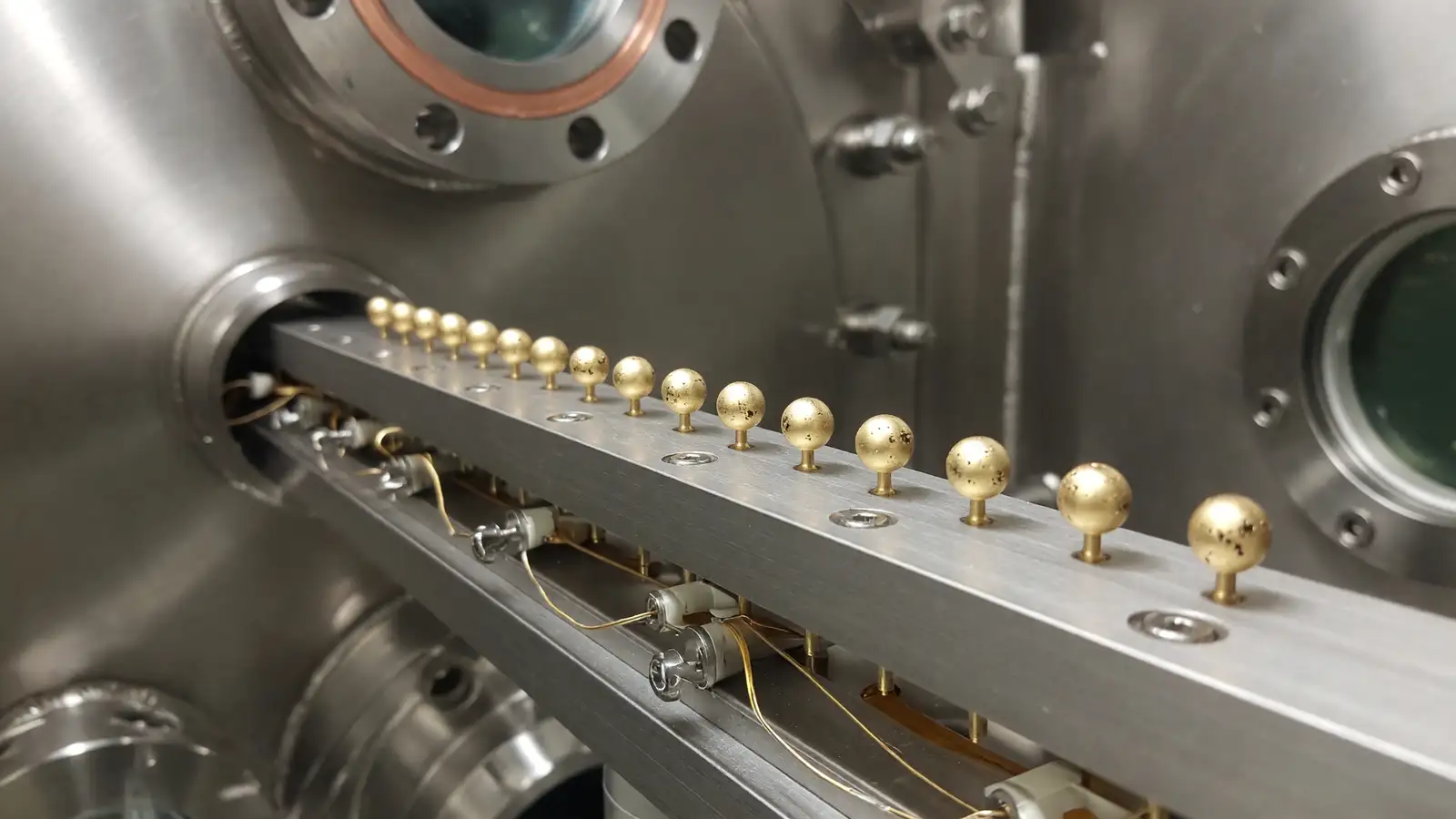
ScienceDaily says the team encoded a string-breaking model into a chain of 13 trapped ions, then used lasers to set how the ions interacted. La Brújula Verde adds the isotope and the bookkeeping. The ions were ytterbium-171. The physical chain held 15. The two at the ends kept the chain trapped and were not part of the simulation. Each ion acted as a spin. The spin stood in for charges and strings.
I want that 15-versus-13 distinction in the open, because “13-qubit quantum computer” headlines tend to drop the ions that are plumbing. They are not a scandal. They are how a trap works. They are also a reminder that the number in the press release is the number that computed, not the number of atoms in the vacuum chamber. If a later paper says 20 ions and means 20 computational ions plus ends, the comparison will be messy unless writers keep the same habit La Brújula Verde used here.
Lasers, not a new chip architecture, are the control knob in both accounts. Tune the interaction, stretch the analog of the string, watch the break. Quantum Zeitgeist says the same thing in fewer words: 13 trapped ions, lasers, Monroe’s group at the Duke Quantum Center. I do not have a runtime, an error rate, or a shot count from any of the three pieces. I am not going to invent one. The result these outlets are willing to print is that the dynamics were observed, and that a classical computer could still reproduce the calculation at this size.
That last clause is the adult sentence in the week. ScienceDaily says classical machines can still perform the calculations at this relatively small scale, and that the researchers expect larger, more complicated experiments to reach problems classical machines cannot. La Brújula Verde says the team checked the 13-ion result against an ordinary computer, which is exactly why a small simulation is scientifically useful. A result you cannot check is a demo. A result you can check is a calibration. The press gloss skips the calibration because “we matched a laptop” is a worse headline than “matter popped into existence.”
Google and QuEra already did the wider version
Duke is not first in the way a headline wants. ScienceDaily says other groups recently hit similar milestones on different hardware. Google used superconducting circuits. QuEra used neutral atoms. Monroe’s comment, which I will quote in substance because it is the comparison he chose: these are the three platforms leading the charge, so the overlap is a useful benchmark for the field.
La Brújula Verde has the geometries ScienceDaily left out, and the geometries are the actual difference. Duke’s run was one spatial dimension. Google’s group used a two-dimensional array of superconducting qubits to look at charge and string dynamics in a (2+1)-dimensional gauge theory, and saw a resonance condition that makes string breaking easier. QuEra, with the University of Innsbruck and Harvard, arranged several dozen rubidium atoms in a kagome lattice, interlocking triangles and hexagons, and also saw string breaking, driven by a many-body resonance.
So the week is not “ions did a thing circuits cannot.” The week is three platforms, two of them already in two dimensions, one of them a 13-ion line that can be checked on a classical machine. I would rather have the checked line than an unchecked plane. I would also rather not pretend the line is ahead. Monroe is not pretending. He called it a benchmark. Benchmarks are how you notice that your one-dimensional result and their resonance are answers to related questions, not the same question.
De now works at QuEra, the neutral-atom group in that comparison. That is a personnel fact from ScienceDaily, not a conflict I can prosecute. The paper’s first author moving to one of the other platforms is how this field is staffed. It does mean a sentence like “Duke versus QuEra” is cleaner in a headline than in the author list. The author list ScienceDaily prints also includes Alessio Lerose, De Luo, Federica M. Surace, Alexander Schuckert, Elizabeth R. Bennewitz, Brayden Ware, William Morong, Kate S. Collins, Zohreh Davoudi, Alexey V. Gorshkov, and Or Katz, alongside De and Monroe. I am printing the list because “Duke scientists” hides a collaboration that already crosses the institutes these comparisons treat as rivals.
What they say the model is not
La Brújula Verde is the outlet that carries the caveats, and it attributes them to the authors. The model is a simplification of the strong nuclear force. More realistic theories, with more dimensions and more complex symmetries, still cannot be simulated. It is also unclear whether the edge-driven breaking mechanism they observed would play any role in real cosmological scenarios.
That second sentence is the one I would tape to the ScienceDaily headline. Edge-driven breaking is a feature of this simulation. Cosmology is a hope. The authors, in that account, do not know if the hope attaches. Monroe’s “short of the Big Bang” line and this caveat are the same humility said from opposite ends. One says the simulator is the best substitute we have for witnessing the event. The other says a mechanism seen at the edge of a 13-ion chain may not be a mechanism of that event. Both can stand. A journalist who prints only the first is writing the headline. A journalist who prints only the second is burying a real experiment. The experiment is real. The cosmological claim is not established in these pieces.
There is a third limit, and it is about quarks rather than about the universe. Confinement says you do not get a free quark by pulling. String breaking says the pull makes more bound particles instead. A simulator that shows the analog of that process has not produced a quark, and it has not produced a proton. It has produced a pattern in a spin chain that the model says corresponds to the process. That correspondence is the whole method. It is also the place a popular story usually cheats, by letting the analogy drop its adjective. “Simulates matter popping into existence” is already an analogy. “Recreated how matter is born” is the analogy with the verb upgraded. La Brújula Verde’s own headline does the upgrade. I am declining it.
This is not a decoder, and it is not a buying thesis
The other quantum story sitting on this site from the same stretch is IonQ running an error decoder on an ordinary CPU. That claim is about keeping a computation alive while the qubits misbehave. This claim is about using a small, well-controlled chain as a physics instrument. NVIDIA’s CUDA-Q logical stack is software aimed at qubits that are not in the box yet. Duke’s ions are in the box. They are also too few, by the authors’ own scale argument, to outrun a classical check. The QUOPS numbers we wrote up were a scoreboard. This paper is not on that scoreboard. Nobody in these three pieces reports a QUOPS figure, and I will not borrow one.
The buying thesis is the easy bad ending, so I will be plain. Nothing here is a reason to buy or sell a quantum stock. De joining QuEra is a job. Monroe calling three platforms a benchmark is a scientist’s sentence, not a market map. A 13-ion result that matches a classical computer is evidence the simulator is honest at a size where honesty is still possible. It is not evidence that the next size will be a product.
What I will keep is the experimental shape. Fifteen ytterbium-171 ions in a trap, thirteen of them computing, lasers setting the interaction, a string-breaking model, a classical check, a one-dimensional geometry sitting next to Google’s plane and QuEra’s kagome lattice, and an author list that already employs people at more than one of those platforms. The matter did not pop into the lab. The model of how matter forms under a pull did run, at a size a laptop can still audit. That is a smaller sentence than the headline. It is the one the paper, as these outlets describe it, can support.