Quantum Computing Is Moving Into the Data Center
Quantum computing has spent a decade inside cleanrooms and cryostats far from any production workload. That is changing this week, and the change is not happening in a physics lab. It is happening in a budget data center in Sydney.
Diraq and Equinix announced on September 1 that they will deploy a Diraq quantum computer at an Equinix data center in Australia. It is a first on two counts: Australia’s first quantum computer to run inside a commercial data center, and the world’s first silicon spin quantum computer to operate in a shared commercial facility. The headline number is not the qubit count, which is modest at eight. It is everything else about how the machine is packed.
Quantum leaves the lab for the data center
The reason this matters is not that eight qubits solve anything. It is that a quantum computer fits into a normal data center without a rebuild. The silicon chip runs at room temperature surroundings with all cryogenic cooling and control electronics self-contained. The whole unit slots in alongside standard servers, needs minimal integration, and draws less than 20kW of power. That last figure is the one that tells you how far quantum hardware has come. A rack that fits in a standard facility and does not blow the power budget is a fundamentally different object from a superconducting machine that needs to be chilled to near absolute zero and kept in a dedicated building.
Andrew Dzurak, the founder and CEO of Diraq, put it plainly in the announcement: quantum computers are about to become as essential to data centers and computing infrastructure as data servers, CPUs, and GPUs. His framing is that the data center is where quantum computing goes mainstream, and that the milestone is in the simplicity. A quantum computer that integrates into an operational data center like any other rack is the whole point. As silicon spin qubits scale toward millions, a system designed to be deployable anywhere, right next to the AI systems reshaping the global economy, becomes a real option.
The silicon chip that slots in like a rack
The technical detail worth sitting with is the upgrade path. Right now the chip holds eight qubits. But scaling to a higher qubit count requires only a chip replacement, with no changes to the surrounding infrastructure. The cryogenics, the control electronics, the power, and the integration all stay put.
That is a genuinely different design philosophy from the modular cryostat approach that other vendors push, where scaling often means bigger machines, more cooling, and a new facility fit-out. Silicon spin qubits have a practical advantage here. They’re built on semiconductor processes that already exist, and they can be controlled with equipment that does not require the giant dilution refrigerators that dominate headlines in this space. The result is a system that can be upgraded in place, which is exactly how enterprise hardware is expected to behave.
The semiconductor link is the overlooked part. Because Diraq’s qubits are etched onto conventional silicon chips, they can in principle ride the same manufacturing scaling that made classical computing cheap. That is not a minor point. Every other serious qubit technology has to build its own fabrication pipeline or borrow one from somewhere it does not quite fit. Silicon spin sits on a billion-dollar infrastructure that already works. The argument is that this is the cheapest path to millions of qubits, and crucially, the design keeps the whole thing rack-shaped as it scales rather than ballooning into a bespoke machine.
Equinix’s operations lead in Australia, Jarrod Nink, framed the collaboration around the proof point rather than the hardware. The deal is meant to demonstrate that a quantum computer can be securely deployed alongside AI, cloud, and high-performance computing environments, and that it can sit inside the digital infrastructure enterprises already rely on. That is the threshold quantum has been trying to cross for years. It is not a chasm of physics; it is a problem of fit, of power, and of just working in a rack.
Trapped ions go where the HPC is
The Sydney deployment is not the only sign that quantum is converging on conventional infrastructure. Two days later, the Jülich Supercomputing Centre and the company eleQtron inaugurated JION, a gate-based trapped-ion quantum computer, and they positioned it explicitly as a hybrid machine to be used alongside classical high-performance computing.
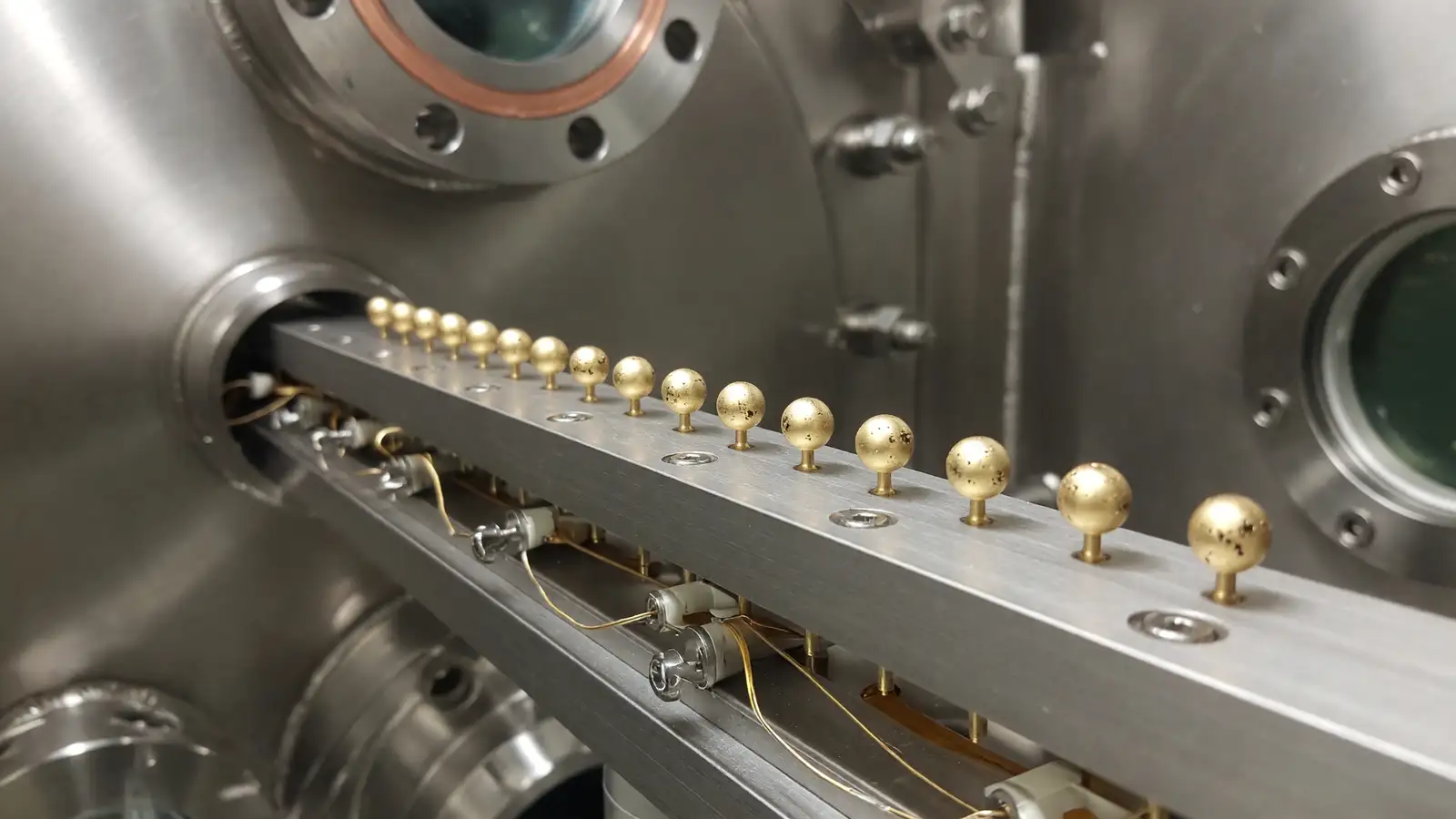
JION is the creative acronym for Jülich trapped-ION quantum computer. Its qubits are ionized ytterbium atoms held in a vacuum by electromagnetic fields, and unlike superconducting systems, the processor does not need to operate anywhere near absolute zero. Instead it uses a control technique called magnetic gradient induced coupling, or MAGIC, developed in Siegen, where microwaves and deliberately generated magnetic field variations control individual qubits and connect them directly to one another. That simplifies the control and, the team argues, opens a path to larger systems.
The institutional angle is the part that matters. JION is part of the EPIQ project, a development partnership for trapped-ion quantum computers in the state of North Rhine-Westphalia, funded at about 21 million euros over four and a half years. The machine sits within JUNIQ, an infrastructure that lets researchers and companies test hybrid HPC-quantum workflows and prepare real applications. That is not a demonstrator. It is a tool intended to be used, and Jülich is positioning itself as a centre for integration and benchmarking where the quantum machine lives right next to classical supercomputing.
Why 20kW and a chip swap matter more than qubit counts
If there is a lesson in both announcements, it is that the quantum field’s favorite metric, qubit count, is not the one that decides whether these machines get used. A cryostat full of ten thousand qubits that needs its own building and a megawatt of cooling is less useful in practice than an eight-qubit rack that runs beside your GPU servers and can be upgraded by swapping a chip.
Power is the enemy of deployment. Standard data centers budget energy per rack, and a quantum machine that pulls a large fraction of a rack’s allocation is not going to sit happily next to the AI accelerators that are already eating the capacity. A system that draws under 20kW is a server-sized object. That is why Diraq’s claim is about the simplicity, not the qubits.
Deployability also changes the economics of accessing quantum. Right now, most quantum access is either a bespoke cloud call to a specialized vendor or a waitlist for a national lab. Put a quantum machine inside a data center on-demand platform and access becomes a provisioning decision, the way you spin up a GPU instance. That is the real commercial shift. You do not buy a quantum computer. You rent a slot in a rack that happens to run one.
What this actually changes for developers and enterprises
For most teams, this week does not change your roadmap tomorrow. An eight-qubit machine is not solving your chemistry problem. But it does change the direction things are heading.
Hybrid quantum-classical workflows are the realistic near-term use case. You run the classical part on HPC or in the cloud, and you hand the quantum part to a machine sitting in a data center nearby, over the same network you already use. JION’s JUNIQ setup is explicitly built for that pattern, and Diraq’s rack-in-a-data-center is designed for it too. The point is to make quantum a co-located accelerator rather than a distant specialty.
It also matters for evaluation. The companies that will win from quantum are not necessarily the ones with the best physics. They are the ones that can put a machine in front of a developer and let them try, iterate, and fail quickly. A quantum computer you can provision next to your AI cluster is an enabling event, even at eight qubits, because it lets the boring work of integration and testing begin.
There is a practical consequence for how you even reach these machines. A quantum computer that lives in a data center on a shared facility can be offered the way clouds offer GPUs today. You request capacity, you queue your job, and you do not think about the cryostat or the physical machine at all. That is how quantum becomes an accelerator rather than a research project. The software layer matters as much as the hardware, and a deployment inside a normal data center is what makes a normal API in front of it possible.
The realistic timeline is still not this year, and probably not next. But the dependency you should watch is not a leap in qubit count. It is the number of quantum machines that can be provisioned like a server.
The bigger picture: Australia and the quantum-hub race
There is a geopolitics angle under all this. Australia wants to be a global hub for quantum innovation, and Equinix is explicitly positioning the collaboration to support that ambition. The country has silicon quantum talent and resources, and a deployment like this is a way to keep that capability at home rather than seeing it exported.
The parallel is not just with the United States and Europe. Nations building commercial data-center infrastructure are quietly becoming the places where quantum gets fielded, not just researched. When the machine of record is a rack in a facility that also runs your cloud and your AI, the boundary between “quantum research” and “quantum infrastructure” disappears.
The honest read is that we are still a long way from useful quantum advantage in a rack. But the shape of the future is now clearer. Computing infrastructure is going to treat quantum as one more accelerator to be deployed, upgraded, and rented, and the machines that win are going to be the ones that fit into the data center rather than the ones that require building one.
For the state of the hardware itself, our coverage of Diraq alongside IBM and EigenQ looks at how quantum hardware is scaling, and the error-correction milestone explains the gap between theoretically possible and practically useful. And if you want to see how the on-device AI story connects to infrastructure, the edge AI overview is a useful companion read.