
IBM Details Nighthawk r3 at 520 Programmable Qubits
IBM's November 11 release says Nighthawk r3 will be built for 10,000 operations on 520 programmable qubits, with a two-chip 1,040-qubit system planned for 2027.
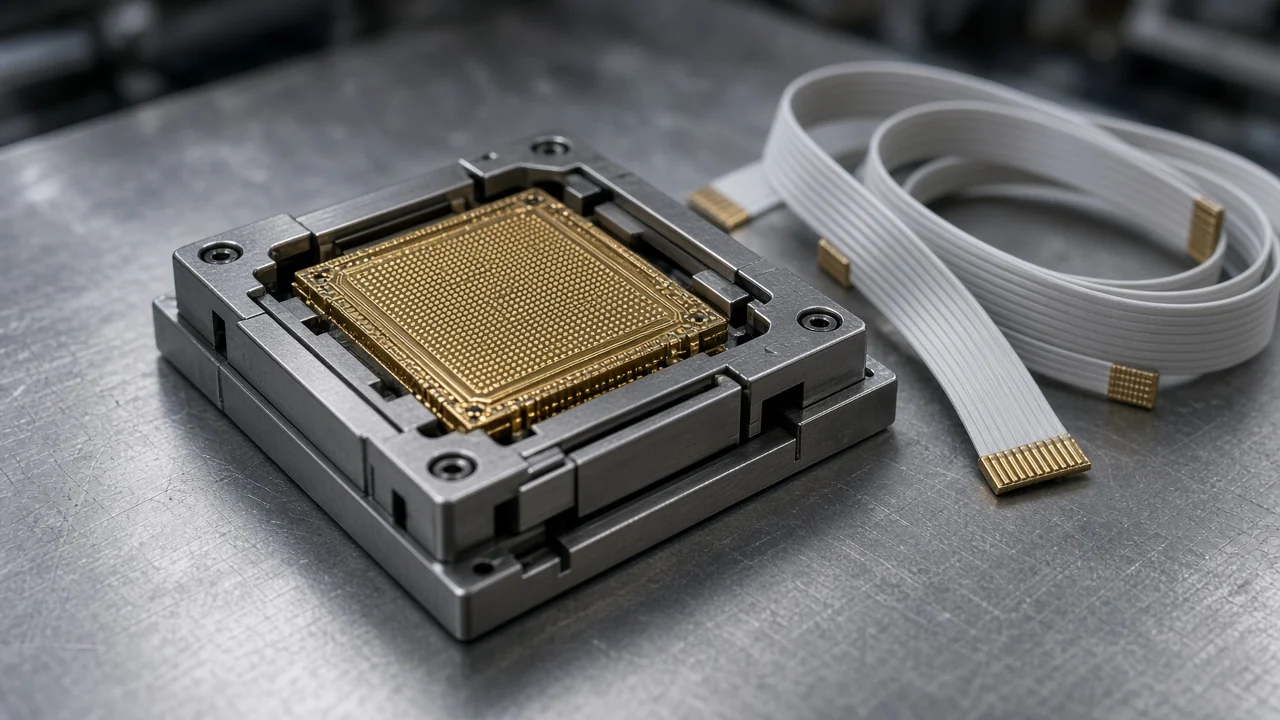
IBM used November 11, 2026, to put a number on the next Nighthawk processor and a different number on the machine that is already taking jobs. The newsroom release from Yorktown Heights says IBM Quantum Nighthawk r3 will be built to execute 10,000 quantum operations across 520 qubits, while the current Nighthawk generation remains the one available today. The same morning, @IBMResearch posted a shorter version: a new processor to support 10k quantum operations on 520 programmable qubits, plus a managed workflow that puts classical and quantum compute in one environment, with the newsroom link attached.
Those two sentences are easy to brief as one product. They are not one product. The release spends most of its length on Nighthawk r2, the processor clients are already using, and it puts r3 in the future tense. A reader who stops at the headline, or at the post, can attach r2’s speedups to a chip that the body says has not been built yet. The rest of this note keeps those generations apart, using only figures the release and IBM’s same-day Quantum Developer Conference write-up actually print.
What the release says r3 will be built to do
The dateline is Yorktown Heights, November 11, 2026. IBM identifies itself as NYSE: IBM and then names IBM Quantum Nighthawk r3 as its next-generation processor. The operative verb is “will be built to accurately execute 10,000 quantum operations across 520 qubits.” The purpose clause is larger and more complex problems, while “maintaining the speed and quality demonstrated by the current generation Nighthawk available today.” Availability today is attached to the current generation, not to r3.
Later in the same release the specification gets a second layer. r3 is “designed to support 10,000 quantum operations on 520 programmable qubits, with 2,034 total physical qubits.” It keeps r2’s square-lattice connectivity and fast operations. It adds 10 chip-to-chip interconnects, which IBM calls l-couplers, meant to join processors into larger systems.
The 2027 plan is also specific. The opening says IBM plans to link two Nighthawk r3 processors into a single system with more than 1,000 qubits. A later paragraph names the system size: two r3 processors connected into a single 1,040-qubit system. Five hundred twenty times two is 1,040. The release does not say the 1,040 count is the sum of the 2,034 physical qubits on each chip. Two chips at 2,034 physical qubits would be a different total, and that total is not the one printed. The figure that matches 1,040 is the programmable count.
Jay Gambetta, identified as Director of IBM Research and IBM Fellow, is quoted on the standard the company wants applied: useful quantum computing hinges on whether results can be delivered with accuracy and speed. The rest of the quote, paraphrased, says Nighthawk is already showing that picture, and that larger machines will sit closer to classical resources on the way to fault tolerance. The quote does not give r3 a ship month.
What the November 11 post leaves out
The IBM Research post is timed Wednesday, November 11, 2026, at 12:00:02 UTC. It says IBM announces Nighthawk r3, “a new processor to support 10k quantum operations on 520 programmable qubits,” and that a new managed workflow on the IBM Quantum Platform brings classical and quantum compute together. It links the newsroom page. It does not say “will be built.” It does not mention 2,034 physical qubits. It does not mention 2027, l-couplers, or the split between r2 measurements and r3 design targets.
That compression is normal for a post. It is also how a design target becomes, in a briefing, a chip that already supports 10,000 operations. “To support” can be read as a present capability. The release’s “will be built to” and “designed to support” are planning language. A note that repeats only the post will drop the tense.
A secondary post from @ApollonVisual shows a second drift. It says the chip has 520 programmable qubits, that two r3 chips will link into a 1,040-qubit system in 2027, and that r2 already posts speedups of up to 19x over Heron. Those points track the release. The date does not. That post says the announcement was published on November 12, 2026. The newsroom page is dated November 11, and the IBM Research post is timestamped November 11. A one-day slip is small until someone uses it to order a sequence of papers. Use the release date.
Nighthawk r2 is the processor with measured throughput
The release says Nighthawk r2 was introduced in September. It delivers up to 100,000 samples per second while supporting accurate computations with more than 7,500 quantum operations on 120 qubits. High-speed qubit reset is the stated reason the gap between circuit executions shrinks. The QDC write-up, dated the same day and bylined IBM Quantum, adds the physical count the release does not put in that paragraph: 120 programmable qubits and 458 physical qubits, on a square lattice. It also states the throughput comparison the release leaves as a raw sample rate: up to 100,000 samples per second is a 25x gain over IBM Quantum Heron.
The same write-up says the increased throughput brought the team to a 100 kHz reset rate, and that this was done without giving up the quality needed to execute circuits with more than 7,500 quantum operations using probabilistic error amplification. It says two roadmap milestones come off the development roadmap because of that. It does not name those milestones in a table a reader can copy. The claim to repeat is the reset rate and the operation count, not a milestone title that was not printed in prose.
AI-driven tuning gets a separate sentence in the write-up. Since deployment, that tuning improved high-error two-qubit gates by up to 7x. “Up to” is the word in the sentence. It is not an average across every gate, and it is not a claim about r3.
Square-lattice connectivity is doing quiet work in both documents. The write-up says the lattice lets r2 run circuits that are harder for classical methods to simulate than the older heavy-hex layout used in an earlier Algorithmiq experiment. The release says r3 retains that connectivity. Retention is a design statement. It is not a new measurement on an r3 chip.
How the speedup figures are scoped
Four multipliers show up in the November 11 material, and they are not the same experiment.
The widest one is “up to 19x.” The release says clients and partners including E.ON, Algorithmiq, and Q-CTRL have executed 34 billion circuits on Nighthawk r2, reporting performance improvements of up to 19x. The QDC write-up uses “more than 34 billion” and adds a qualifier the release headline does not: “according to our team’s calculations.” Both pages say the improvements are beyond previous IBM quantum processors. Neither page publishes the per-partner split that would show whether 19x is one workload, a best case, or a median. “Up to” and “reporting” are the verbs. Treat 19x as a ceiling the companies and IBM are reporting, with the baseline named as previous IBM processors.
E.ON’s figure is narrower. The release says E.ON reported a 15x speedup on Nighthawk r2 in quantum machine learning for energy grid optimization. It then says that speedup, and the Oak Ridge figure below, were achieved over previous work on IBM Quantum Heron. Grid optimization is an energy-operations workload. It is not, on this page, a tariff, a capacity market, or a procurement result.
IBM’s own Oak Ridge comparison is a 12x speedup of an experiment run earlier this year with Oak Ridge National Laboratory. The release says the experiment simulated real magnetic materials and produced results consistent with neutron scattering experiments. Consistency with a scattering experiment is a scientific check on the output, not a claim that every magnetic material of industrial interest is now in reach.
Algorithmiq is the fourth multiplier, and it is attached to a named prior result. Quantum advantage experiments IBM and partners published in July were first run on Heron, with circuits and results described as openly available through a community Quantum Advantage Tracker. An Algorithmiq experiment simulating a heterogeneous quantum material has been extended to r2. The release says those circuits execute 8 times faster than the original experiment on Heron. At the same time, the new circuits are described as harder for classical computers: an estimated 240 times more memory to reach comparable accuracy with leading classical tensor-network methods. The QDC write-up tightens that comparison. At fixed accuracy, those classical methods would need an estimated 240x more memory than for the original heavy-hex implementation, while the quantum computation runs 8x faster.
The 8x and the 240x point in different directions, and both can be true. Faster sampling on the quantum side does not, by itself, prove a classical simulator has become 240 times more expensive. The memory estimate is about the new circuits, which use the square lattice, versus the older heavy-hex version. A briefing that says “Nighthawk is 240x faster” has swapped a classical memory estimate for a quantum runtime.
Quantum Elements and ParityQC are named as partners reporting significant performance improvements on their own r2 workloads. No multiplier is printed for either name in the release. “Significant” is not a number. Leave it as a name, not a 19x.
The sample-rate logic underneath these figures is worth stating in the release’s own terms. A quantum computer returns an answer in samples. Each run of a circuit returns one result. The release says applications increasingly need circuits of thousands of operations on about 100 qubits or more, generating millions to billions of samples. Scale and quality make the computation possible. Speed decides whether that many samples finish in a practical time and at a reasonable cost. That is why 100,000 samples per second is not a decorative spec next to 7,500 operations. The operation count is the length of one circuit. The sample rate is how fast the machine can repeat it.
The 2027 link plan, and the coupler evidence already in hand
r3’s 10 l-couplers are a design count. The evidence IBM cites for the method is a demonstration on an earlier chip. This year, the release says, IBM connected Nighthawk r1 processors using four l-couplers, achieving 99.3 percent quantum state transfer fidelity, and is progressing toward a 99.9 percent target. The QDC write-up is slightly more precise about the distribution. It says two Nighthawk processors were linked with four l-couplers at 99 percent average state transfer fidelity, with a best result of 99.3 percent. The 99.3 percent figure in the release lines up with the best result in the write-up, not necessarily with the average. A slide that prints only 99.3 percent is using the better of the two published numbers.
Four demonstrated couplers are not ten designed couplers. The write-up also says Starling, the fault-tolerant system discussed below, will need more than 100 l-couplers working together. The r1 demonstration is a repeatability proof point, in IBM’s framing, not a finished interconnect fabric.
Cryogenics is the other modular claim with a measurement attached. Both pages say IBM connected two cryogenic modules into a single system for the first time, reached operating temperature in under five days, and cooled below 15 millikelvin. That is a cooling and integration result. It is not a qubit-count result, and it is not an r3 fidelity result. It does answer a practical objection: a two-chip plan is empty if the fridge cannot hold two modules. The pages say the two-module cool-down has been done.
Put next to other modular hardware in the same month, the method is different even when the ambition rhymes. Universal Quantum’s integrated processing unit, covered in an earlier note on the modular trapped-ion iQPU, moves ions between chips with electric fields on a silicon trap, rather than with microwave couplers between superconducting dies in a shared cryostat. Both announcements are about crossing a chip boundary. They are not interchangeable parts, and a fidelity number from one does not travel to the other.
Three clocks: 2027, late 2028, and 2029
The November 11 material and the next day’s post name three different horizons. Mixing them produces a single “IBM quantum arrives in 2027” line that none of the pages support.
The 2027 date in the release is the two-chip Nighthawk r3 system, the 1,040-qubit machine built by linking two processors that are themselves still described as to-be-built. The QDC write-up adds a software date in the same year: Backend v3, coming in 2027, is described as an evolution of the backend interface so that classical pre-processing, quantum execution, and classical post-processing can be expressed as one program rather than as isolated circuit runs. That is a developer-interface plan. It is not the same sentence as the 1,040-qubit system.
A later clock sits in the write-up’s discussion of the Oak Ridge co-design work. It says the work aligns with the U.S. Department of Energy’s Genesis Mission, which aims to reach 100 logical qubits running 100,000 hard operations by late 2028. Logical qubits are not programmable qubits. One hundred logical qubits is not 520 programmable qubits, and late 2028 is not 2027. The write-up does not say Nighthawk r3 is that Genesis system.
The third clock is IBM Quantum Starling. The QDC write-up calls Starling the first fault-tolerant computer IBM plans to deliver, targeted for 2029, and ties it to circuits at a scale of 100 million operations, running in minutes rather than months. On November 12, 2026, at 14:00:01 UTC, @IBMResearch posted that IBM is building Starling, that it is still a few years away, and that the pathway from QPUs to modular cryogenics is clear. “A few years” from November 2026 is compatible with a 2029 target. The post does not print 2029. The write-up does. Use the write-up for the year and the post for the public phrasing.
The write-up also describes component work on the way to Starling that should not be briefed as r3 specs. IBM Quantum Loon, first showcased at QDC 2025, is described as bringing ingredients of an error-correcting qLDPC processor onto one chip, with measured performance comparable to Nighthawk r2. Design changes are said to cut Josephson junctions in each Starling module by more than half versus earlier plans, from about 5,000 to 2,000, helped by a qLDPC code that needs five qubit connections instead of six, plus denser on-chip c-couplers. Decoding algorithms are said to meet the performance Starling needs, with a dedicated decoder chip in development. The latest cryogenic control ASICs are said to match the gate performance of room-temperature electronics. Each of those sentences is a Starling-path claim in a November 11 blog post. None of them is a measured r3 gate error.
Classical compute in the same announcement
The release’s second product, easily missed if the briefing is only a qubit count, is the IBM Quantum Platform change. Users can integrate quantum workflows with classical compute from a laptop or a supercomputer, or with HPC and classical resources newly available on the platform. The IBM Research post reduces that to one clause about a managed workflow. The release gives two workload examples.
IBM and RIKEN scientists, using the new environment, executed their original sample-based quantum diagonalization workflow roughly 5 times faster while performing 100 times more computations than in the original study. The release points to two arXiv papers for that comparison. The 5x and the 100x are figures the newsroom text attributes to that execution. A footnote says the project is supported by NEDO, under Japan’s Ministry of Economy, Trade and Industry, inside a named post-5G infrastructure program. That funding line is about the project, not a claim that NEDO certified the speedup.
Cleveland Clinic and RIKEN are the second example. The release says they used the platform to automatically process 608 million samples for modeling biologically relevant structures, 33 times faster than without workflow automation. “Biologically relevant structures” is the phrase in the release. It is a computation-timing claim about a workflow. It is not a clinical result, a treatment claim, or a statement that a hospital should change a protocol. The 33x is versus the same workflow without the automation, which is a different baseline from the Heron comparisons earlier in the page.
A third classical tie is dated five days earlier and only summarized on November 11. The release says IBM recently launched a co-design platform for quantum error correction with Oak Ridge National Laboratory and AMD, physically co-locating Nighthawk with ORNL’s Umbra HPC system, powered by AMD Instinct MI355X GPUs and 5th Gen AMD EPYC CPUs. The write-up names the co-located processor as Nighthawk r2. Error correction research, in this framing, needs mid-circuit measurement, fast classical feedback, and real-time control, exercised at a scale real codes demand. Co-location is the point: the quantum processor and the classical decoder hardware sit together so the algorithms can be designed across both, rather than in isolation. The November 11 pages do not print a new logical-qubit count from that co-located system.
Pulse-level access on the platform is mentioned as a research tool for timing operations, resetting qubits faster, and pulling more information from measurements. That is a control feature. It is not a user-facing application, and it is not an invitation to copy a pulse schedule from a press release. No pulse parameters appear in those pages.
Programmable qubits, physical qubits, and a two-chip total
The count that travels is 520. The count that explains the chip is 2,034. The count that explains 2027 is 1,040. They answer different questions.
Programmable qubits are the ones a circuit can use as computational qubits. Physical qubits include the extra devices a superconducting chip uses for coupling, readout, or other overhead, depending on how the vendor draws the line. IBM’s pages do not publish a parts list that assigns each of the 2,034 devices a role. What they do publish is the pair: 520 programmable, 2,034 physical, on r3. On r2 the write-up’s pair is 120 programmable and 458 physical.
The ratios are similar, which is a reading of the arithmetic, not a sentence IBM printed. 2,034 divided by 520 is about 3.91 physical qubits per programmable qubit. 458 divided by 120 is about 3.82. The overhead ratio did not obviously collapse in the r3 specification. A reader who hears “520 qubits” and a reader who hears “2,034 qubits” are not disagreeing about a measurement. They are quoting different lines. The line that matches the 10,000-operation target is the programmable one: the release says 10,000 quantum operations on 520 programmable qubits.
The 2027 system follows the programmable line as well. Two processors at 520 programmable qubits add to 1,040, which is the system size the release names, and which also satisfies the earlier “more than 1,000 qubits.” Nothing in the pages says the 2027 system has 4,068 physical qubits, which is what two chips at 2,034 would imply if the link plan counted physical devices. Do not invent that total. Do not replace 1,040 with it either.
Operation counts need the same care. r2 is described as supporting accurate computations with more than 7,500 quantum operations, as a capability already in use. r3 is described as designed to support 10,000. The step from 7,500 to 10,000 is real on the page, and it is smaller than the step from 120 programmable qubits to 520. A briefing that leads with “almost 4x the qubits” is using the programmable ratio, 520 divided by 120, which is about 4.3. A briefing that leads with “10,000 operations” is using a design target that sits a third above the r2 operation count the pages treat as demonstrated. Both ratios can be stated. They should not be fused into “four times more powerful.”
Sample rate is a third axis, and r3 does not get a new one in the release. The 100,000 samples per second, the 25x gain over Heron, and the 100 kHz reset are r2 figures. The release says r3 is meant to maintain the speed and quality the current generation has demonstrated, and to extend that high-speed architecture to larger machines. “Maintain” is not a new measured sample rate. Until an r3 device posts its own samples per second, the throughput number in a briefing should stay labeled r2.
What the pages do not provide
Several blanks are as useful as the numbers, because they mark where a summary usually invents a sentence.
There is no r3 availability month. December, a quarter, or “shipping now” would be an addition. r2 is the generation called available today. r3 is will-be-built.
There is no price, no cloud queue name, and no region list for r3 access. The platform discussion is about workflow integration and classical resources, not about a new paid tier.
There is no r3 two-qubit error rate, no r3 readout fidelity, and no r3 state-transfer number. The 99.3 percent and the 99 percent average belong to the l-coupler demonstration on earlier Nighthawk processors. The 7x gate improvement belongs to AI-driven tuning on deployed devices, in a paragraph about r2. Moving either figure onto r3 is a transcription error.
There is no named customer running r3. E.ON, Algorithmiq, Q-CTRL, Quantum Elements, ParityQC, Oak Ridge, RIKEN, and Cleveland Clinic appear in r2 or platform paragraphs. A sentence that says those organizations have executed circuits on r3 is not in the release.
There is no independent recount of the 34 billion circuits in either page. The write-up attributes that total to the team’s calculations. The release states it as executed. The attribution stays with IBM.
The July advantage experiments are described as first run on Heron, with open circuits for independent testing. The November pages say an Algorithmiq experiment from that set now runs on r2, faster, on harder circuits. They do not say every July experiment has been repeated on r2, and they do not say r3 has entered that tracker.
How to brief the week without mixing generations
A usable briefing has four lines and a refusal to merge them.
First, the design target. On November 11, 2026, IBM said Nighthawk r3 will be built to run 10,000 quantum operations on 520 programmable qubits, with 2,034 physical qubits on the processor, square-lattice connectivity carried over from r2, and 10 l-couplers intended for multi-chip systems.
Second, the machine with measurements. Nighthawk r2, introduced in September and described as available now, is specified at 120 programmable qubits and 458 physical qubits, more than 7,500 operations, and up to 100,000 samples per second, a 25x throughput gain over Heron in the QDC write-up. Reported speedups on that processor include up to 19x across a set of partner workloads, 15x reported by E.ON on a grid-optimization machine-learning workload, 12x on an Oak Ridge magnetic-materials experiment, and 8x on an extended Algorithmiq circuit relative to the original Heron run, alongside an estimated 240x classical memory increase for the new circuits at comparable accuracy.
Third, the 2027 system. Two r3 processors are planned to form a 1,040-qubit system. The coupler evidence on hand is a four-coupler link between earlier Nighthawk processors, at about 99 percent average state transfer and a best of 99.3 percent, against a 99.9 percent target. Two cryogenic modules have been cooled as one system, below 15 millikelvin, in under five days.
Fourth, the longer clocks. Starling is targeted for 2029 in the QDC write-up and described as a few years away in the November 12 IBM Research post. A Department of Energy Genesis Mission aim of 100 logical qubits and 100,000 hard operations by late 2028 is a third date, printed in the same write-up, and it is not the r3 ship plan.
The original point is the split the headline blurs. “Demonstrates new levels of speed and quality” is a fair description of the r2 paragraphs: sample rate, partner-reported speedups, and a classical memory estimate on harder circuits. “Plans to scale beyond 1,000 qubits in 2027” is a fair description of the r3 paragraphs: a processor to be built, then a pair of them. The IBM Research post is accurate on the 520 and the 10k, and silent on which of those sentences is a measurement. Secondary posts can move the date by a day and still repeat the right integers. The integers are not the risk. The risk is stapling r2’s 19x, r3’s 520, and Starling’s 2029 into one device that none of the pages describe.
This is a hardware briefing drawn from IBM’s November 11 release, the same-day QDC write-up, and two IBM Research posts. It is not a recommendation to buy or sell IBM shares, and it is not a clinical reading of the Cleveland Clinic workflow timing. Partner speedups remain company-reported figures with the baselines named above. Where a page uses “up to,” “estimated,” “designed to,” or “will be built,” those words are part of the fact.