
Blackmagic Ambisonic Microphone for Apple Vision Pro
Blackmagic's new ambisonic mic uses 108 MEMS capsules and Apple-licensed filters to record 64 channels of 32-bit spatial audio, priced at $1,695 with December availability.
Blackmagic Design has announced a microphone aimed at immersive video, not a new headset. The announcement, reported by Scott Hayden at Road to VR on November 13, 2026, describes a pro tool that captures spatial audio for Apple Immersive productions, including what the piece calls built-in support for Apple Vision Pro. The same day, @RtoVR posted the headline and that link.
The useful reading is the pipeline the body actually specifies. A lede that says “for Apple Vision Pro” can be heard as a peripheral that pairs with the headset. The paragraphs under it describe a camera-and-computer recorder whose encoding comes from Apple-licensed filters, and whose immersive files are written by Blackmagic’s URSA Cine Immersive camera. Those are different products. Mixing them up is how a $1,695 microphone gets briefed as a Vision Pro accessory.
What was announced, in the words that carry numbers
The product name is the Blackmagic Ambisonic Microphone. It is an ambisonic array of 108 digital MEMS microphones, meant to capture the entire sound field. An internal processor runs Apple-licensed array geometry and encoding filters. Those filters convert the 108 signals into 64 channels of 32-bit audio in real time. The stated reason for doing that conversion inside the body is to drop external breakout boxes and separate encoding software.
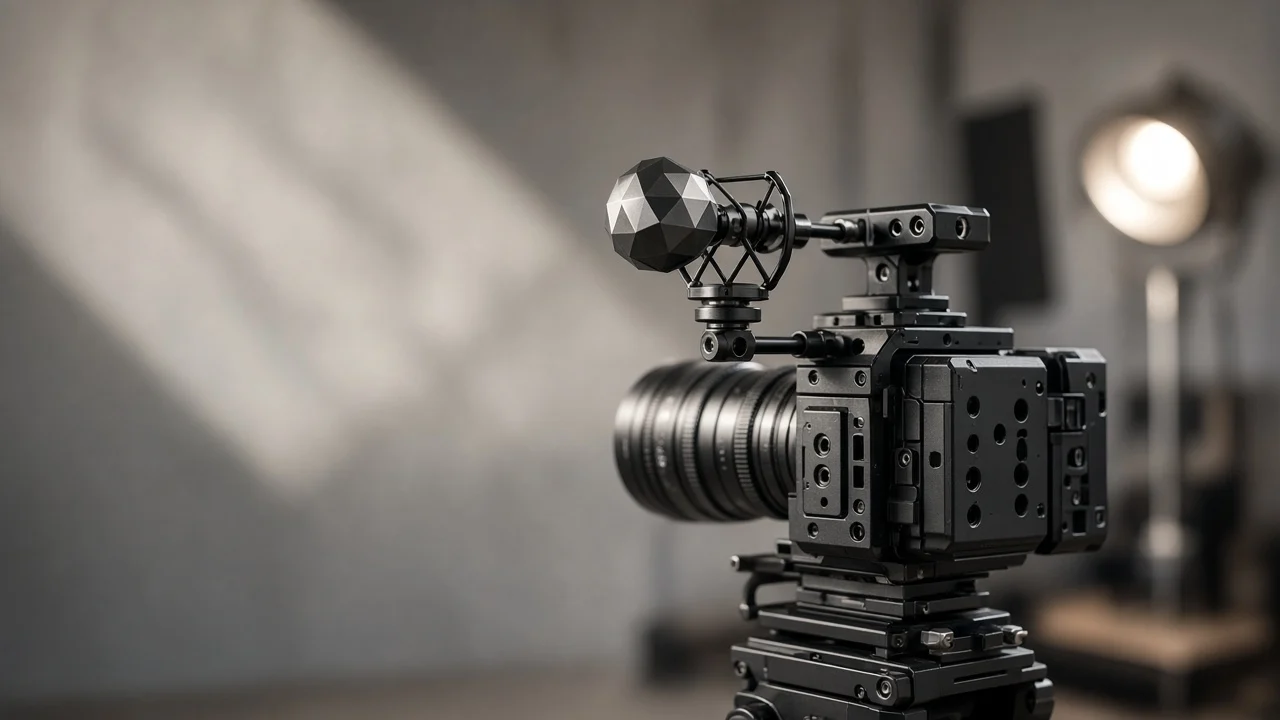
Price is $1,695. Road to VR marks that figure as professional pricing. The microphones sit flush in a solid, faceted metal body. Blackmagic says the unit is small enough to fit in the palm of a hand, or to mount on top of a camera. The page does not print weight, dimensions, or a photo scale. “Palm of your hand” and “on top of a camera” are the size claims that exist. A rack-unit height or a gram weight would be an addition.
Power and data share one cable. The microphone connects and is powered over USB-C. Blackmagic says it is class compliant, so there are no drivers or plug-ins to install. Class compliant is a USB claim about the host seeing a standard audio device. It is not, on this page, a claim about wireless pairing, a Vision Pro setting, or a Bluetooth profile. The cable is the connection the announcement describes.
Availability is a month, not a day. There is no precise ship date. The company says to expect availability in December. No region list, no preorder link, and no “shipping now” sentence appear in the report. December is the schedule a buyer can repeat without adding a weekday.
Three recording paths, and one converter that is not the mic
The announcement names three places the signal can go, plus a converter that is a separate item.
First, the camera path. Customers can mount the microphone on Blackmagic’s recently released URSA Cine Immersive camera, plug it in, and capture spatial audio for Apple Immersive content. Spatial audio records directly into the camera’s immersive files. That sentence is the closest the page comes to an end-to-end immersive workflow. The headset is the playback target of Apple Immersive content in the framing of the piece. The recorder in this path is the camera, not Vision Pro itself.
Second, the computer path. The microphone can connect to a computer and record and mix in real time with Fairlight Live. Fairlight is Blackmagic’s audio tool. The page does not say which desktop operating systems were tested, and it does not say the class-compliant mode and the Fairlight path are different sample rates. It says you can record and mix in real time there.
Third, the phone path. The microphone can record directly to an iPhone using the Blackmagic Camera app. Again, the page does not add a list of supported iPhone models. “Directly to iPhone” and the app name are the facts.
A USB to SMPTE-2110 converter will be available for advanced broadcast workflows. “Will be available” puts the converter on a different clock from the microphone’s December line. The page does not price the converter, does not say it ships in December, and does not say the microphone speaks SMPTE-2110 by itself. Broadcast users who need 2110 are waiting on a second product. Treating 2110 as a feature of the $1,695 unit overreads the sentence.
Grant Petty, Blackmagic Design’s CEO, ties the project to the camera collaboration rather than to a headset accessory program. In the quote carried by Road to VR, the microphone started while Blackmagic was working with Apple on the URSA Cine Immersive camera. Petty says he heard a high-resolution spatial capture for the first time and describes it as hearing an acoustic reality. The licensing sentence is specific: “Apple licensed their array geometry and the ambisonic encoding filters, we did the engineering and design, and the result is an ambisonic microphone where you just plug in one cable and capture true spatial audio.”
That quote is the ownership split. Geometry and encoding filters are Apple’s, licensed. Engineering and industrial design are Blackmagic’s. One cable is the user-facing claim, matching the USB-C description above. “True spatial audio” is Petty’s phrase for the result. It is not a measurement, and the page does not attach a THD figure, a noise floor, or a frequency response to it.
What “built-in support for Apple Vision Pro” is doing in the lede
Road to VR’s opening sentence says the microphone is designed to capture spatial audio for immersive video production, including built-in support for Apple Vision Pro. The support that the later paragraphs document is the Apple-licensed array geometry and encoding, plus recording into immersive files on the URSA Cine Immersive, aimed at Apple Immersive content. The page does not say the microphone pairs as a live input on a Vision Pro worn in the room. It does not name a visionOS app for this mic. It does not say a Vision Pro can power the array over USB-C. Those would be different products, or at least different sentences.
The distinction matters for anyone writing a shot list. If the job is Apple Immersive footage that will be watched on Vision Pro, the path on the page is camera plus this microphone, with spatial audio inside the camera’s immersive file. If the job is a live call on a Vision Pro, or a room-scale capture driven from the headset, this announcement does not describe that setup. “Built-in support” here is support for the format and the licensed encode, as the body explains it, not a line item in the headset’s Bluetooth menu. The page never mentions Bluetooth.
A second reading of Petty’s quote points the same way. The origin story is the URSA Cine Immersive collaboration. The thing that impressed him was a high-resolution spatial capture he heard while that camera work was underway. The product that resulted still plugs in with one cable. Nothing in the quote relocates the microphone onto the headset.
What 108 into 64 actually commits to
The array count and the channel count are both on the page, and they are not the same number. One hundred eight digital MEMS capsules feed an internal processor. The processor emits 64 channels of 32-bit audio, in real time, using Apple’s licensed geometry and encoding filters. The announcement presents that reduction as the feature that removes breakout boxes and separate encoding software. It does not publish the ambisonic order those 64 channels correspond to, and it does not say whether a host can also record the raw 108 capsules. The deliverable the page names is the 64-channel, 32-bit stream.
Real time is the constraint that makes the internal processor the product, rather than a passive array. If encoding waited for a workstation, the “no separate encoding software” line would not hold. The page says the conversion happens in the microphone. It does not say what happens if the USB host cannot keep up, and it does not publish a latency figure. Real time here means the encode is inside the device, not that a frame of latency has been measured in print.
Thirty-two-bit is a word length, not a sample rate. The page does not state 48 kHz, 96 kHz, or any other rate. A spec sheet that needs the rate is not completed by this announcement. The same gap applies to channel mapping: 64 channels are named, the order of an ambisonic bus is not.
MEMS, flush-mounted in a faceted metal body, is the mechanical description. Flush mounting is a durability and wind-noise choice the page does not analyze. It does say the capsules are mounted flush, in a solid faceted body, and that the body is meant to sit in a palm or on a camera. For a camera-top mount, the missing weight is the practical unknown. “Small enough to mount on top of a camera” is Blackmagic’s claim, reported as such. It is not a tested payload limit for a particular cage or a particular URSA configuration beyond the recently released URSA Cine Immersive, which is the camera the page names.
How the $1,695 price sits in the announcement
The price is stated once, as professional pricing. The page does not compare it with another ambisonic microphone, does not list a street price versus MSRP, and does not mention a kit that bundles the URSA Cine Immersive. $1,695 is the microphone. The camera is “recently released,” which means a buyer who does not already have that body is looking at a second purchase the article does not price.
The three paths do not all require that camera. Fairlight Live on a computer, and the Blackmagic Camera app on an iPhone, are alternate records. A studio that wants the spatial file inside an Apple Immersive camera master is the studio the URSA sentence is for. A studio that wants a real-time mix on a workstation can stop at Fairlight, on the words of the page. An iPhone record is a third, narrower path: the Blackmagic Camera app, not a generic voice-memo claim.
Class compliant and “no drivers or plug-ins” lower the software cost of trying the computer path. They do not lower the $1,695. They also do not imply that Fairlight Live is free, or that the Camera app replaces a digital audio workstation for a 64-channel mix. The page says you can record and mix in real time with Fairlight Live. It does not inventory what else a 64-channel session needs.
December availability, without a day, means the price is not a ship-today price. A rental house planning a December immersive shoot cannot treat “availability in December” as “on the shelf December 1.” The sentence is the company’s expectation, reported on November 13. No retailer is named.
What the announcement leaves off the page
No sample rate. No weight. No battery, which fits a USB-C powered device, but the page does not discuss bus power limits or a powered hub. No visionOS version. No list of countries. No return window. No statement that existing URSA Cine Immersive owners need a firmware update before the microphone mounts. No measurement behind “acoustic reality” beyond Petty’s description of what he heard.
The affiliate disclaimer on the Road to VR page is about the publication’s links, not about a Blackmagic discount. It does not change the $1,695 figure.
The SMPTE-2110 converter is the clearest “not yet” in the piece. Broadcast workflows that need that transport are pointed at a future accessory. Immersive workflows that need Apple’s encode are pointed at the microphone itself, provided the December window holds and the recording path matches one of the three named hosts: the URSA Cine Immersive, a computer running Fairlight Live, or an iPhone running the Blackmagic Camera app.
For Vision Pro as a viewing platform, the announcement’s concrete claim is spatial audio inside Apple Immersive files, produced with Apple-licensed geometry and filters, from a one-cable microphone Blackmagic engineered. For Vision Pro as a capture device, the announcement is silent. Keeping those two roles apart is the difference between ordering a $1,695 mic for a camera package and expecting it to show up in the headset’s input list.